|
Getting your Trinity Audio player ready... |
Table of Contents
- 1 What is a Drainage Geocomposite?
- 2 Why Choose a Geocomposite Over Traditional Drainage Layers?
- 3 Key Applications of a Geocomposite Drainage Layer
- 4 Types of Geocomposite Drains
- 5 How to Choose the Right Drainage Composite
- 6 Installation Tips for Success
- 7 Conclusion: Choosing the Right Geocomposite Partner
- 8 FAQs
Ever dealt with water seeping through basement walls? How about large potholes developing in roads after heavy rains?
Problems like these are commonplace, with water ruining the integrity of entire structures. It builds pressure behind walls and weakens roads, turning everything muddy.
The solution? Using drainage geocomposites. It is the modern way to improve a structure’s durability.
Drainage geocomposites are the best way for any construction site to ensure the integrity of its structure. It is lighter, smarter, and more reliable than gravel used to protect roads.
Working with retaining walls, foundations, or landfills? Installing geocomposite material during construction can significantly reduce the risk of water damage.
Let me break down how exactly you can achieve the benefits of a geocomposite drainage layer.
What is a Drainage Geocomposite?
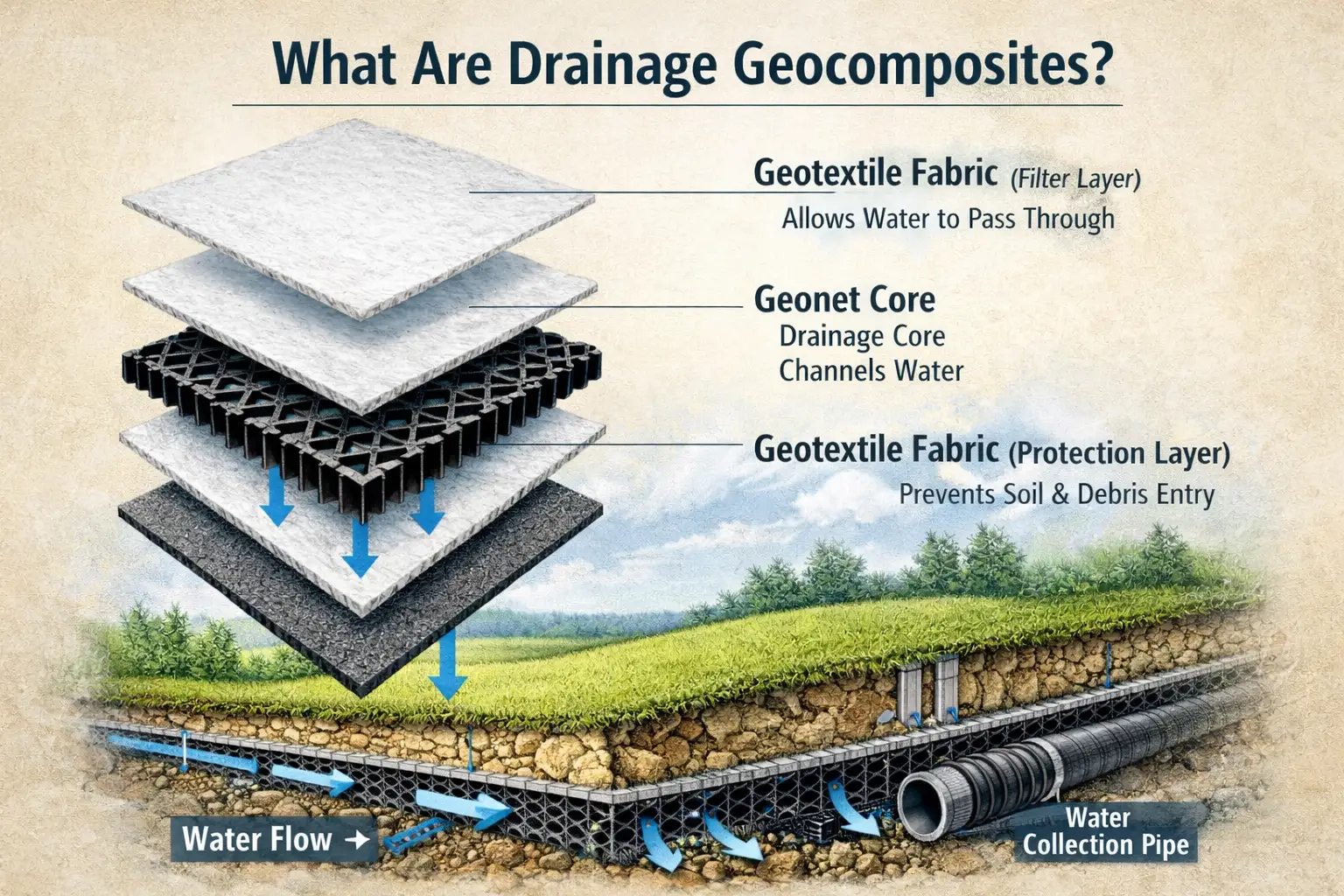
Think of drainage geocomposite as engineered materials sandwiched together to form a uniform material. It is specifically designed to efficiently move water away from structures.
Essentially, it is a high-tech drain that can provide incredible benefits at lower costs. A typical setup using geocomposites looks like:
- A plastic drainage core, typically made of HDPE or polystyrene, that helps form individual water drainage channels.
- A geotextile filter fabric is also attached to the sides to facilitate water passage while preventing soil intrusion.
Some models also come with a geomembrane lining for effective waterproofing. This makes it a complete water protection system.
Geocomposites are thus a lightweight sheet that is very easy to install. Rather than using heavy gravel, you can just install a geocomposite against a wall or even underground.
Why Choose a Geocomposite Over Traditional Drainage Layers?
You might be wondering: why should I replace gravel, a proven method, with a synthetic sheet?
Well, the answer to that question is the amazing key advantages it offers in comparison:
Factor | Traditional Gravel Layer | Drainage Geocomposite |
Weight | Heavy; requires trucks and machinery | Lightweight; easy to handle and transport |
Installation Speed | Slow; needs excavation and careful placement | Fast; simply roll out and connect |
Space Required | Thick layers take up space | Thin profile saves valuable space |
Material Cost | High due to quarrying and transport | Lower overall project cost |
Performance | Can clog over time | Consistent, long-term flow capacity |
Environmental Impact | High carbon footprint | Lower emissions, less resource use |
Moreover, a geocomposite drainage layer can increase permeability by 2x to 3x compared to a conventional granular sub-base.
For a two-lane road, this means saving up to 2,500 cubic meters of material per kilometer!
Key Applications of a Geocomposite Drainage Layer
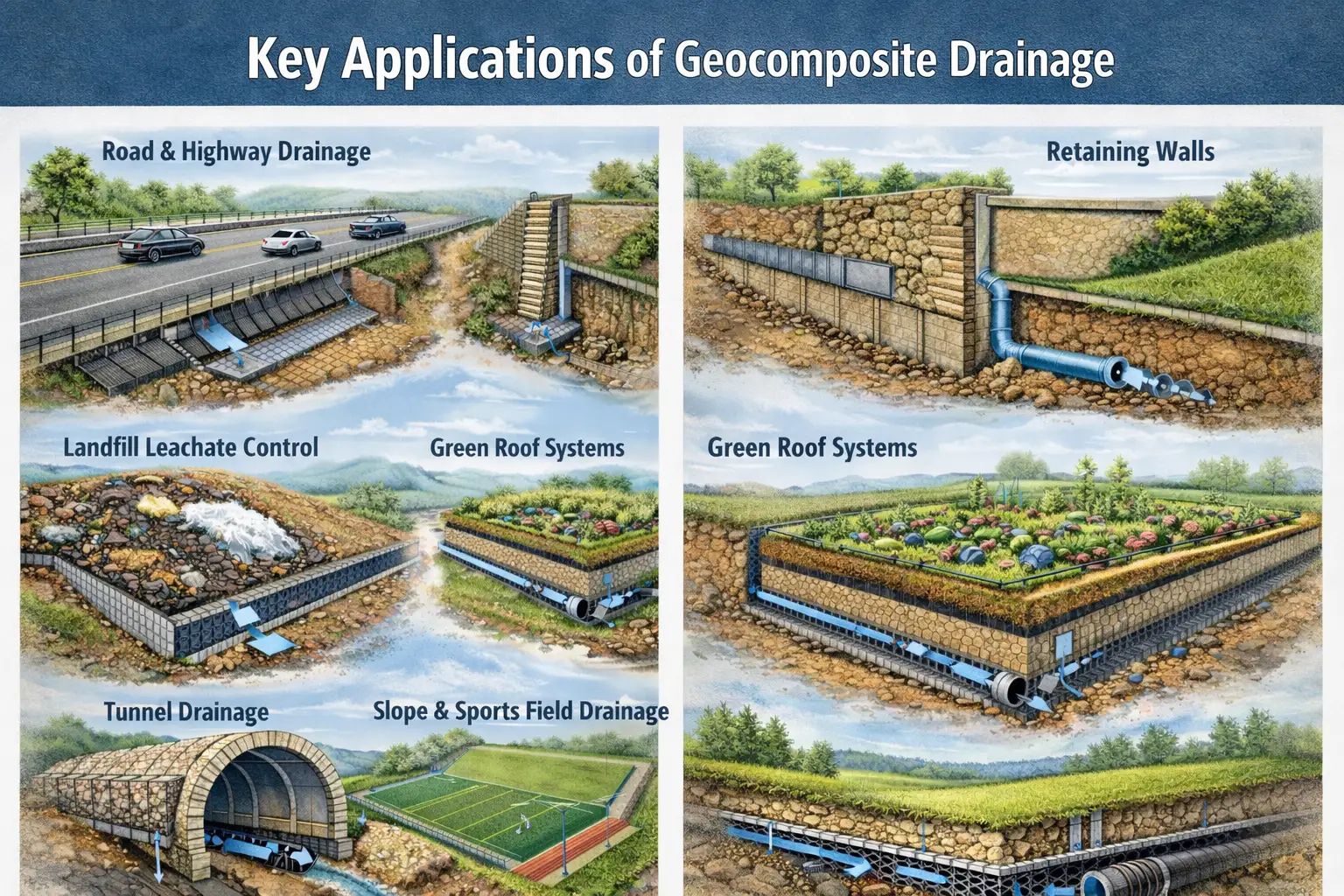
The versatility offered by geocomposite drainage systems makes them useful across many construction services.
Retaining Walls and Foundation Walls
Water pressure usually builds up behind retaining and basement walls. This leads to leaks and prolonged structural damage.
Using a geocomposite wall drain makes it easy to relieve this pressure. These dimple boards create a channel for the water to drain out of, preserving the walls.
Using a collection pipe at the base, this water can then be moved out of the structure.
For broader implementation, water management construction solutions highlight how these systems are applied across large-scale projects.
Road and Highway Drainage
Any water trapped under a road pavement can create potholes and cracking. Placing a geocomposite drainage layer beneath the road base is a key application of geosynthetics in road construction, helping solve this problem effectively.
It removes the subsurface water that creates such cracks in the first place. Using drainage geonets, builders can easily protect pavements from frost damage as well.
Landfill Leachate Collection
Modern sanitary landfills often use multiple layers of protection. This is done to prevent contamination and leaks.
Geocomposites are a good means of forming drainage layers that collect leachate (the liquid that flows from waste).
Green Roofs and Plaza Decks
On many roof gardens and elevated decks, excess water typically needs to drain quickly. This must be achieved without increasing weight.
Using thin geocomposite sheets, water is efficiently directed into the roof drains. This is done while protecting the waterproof membrane beneath the sheet.
Tunnels and Underground Structures
During tunnel construction, groundwater often seeps into the structure. To prevent this, geocomposite drains are placed before the tunnel lining.
The geocomposite drainage layer captures and redirects any groundwater. It restores the tunnel’s durability and prevents water from halting construction.
Types of Geocomposite Drains
Not every geocomposite is made the same. Here are the most common formats of geocomposites:
Type | Best For | Description |
Sheet Drain | Foundation walls, plaza decks | Dimpled plastic core with geotextile on the sides |
Strip Drain | Trench drains, athletic fields | Narrow, linear drain for targeted water collection |
Geonet Composite | Landfills, road bases | Open grid core providing high flow capacity. |
Drainage Mat | Green roofs, under-slab drainage | Flexible mat with drainage channels and filter fabric |
How to Choose the Right Drainage Composite
Select the right geocomposite drainage material by considering:
- The amount of load your geocomposite can withstand
- The amount of water that needs to be drained
- The type of soil that needs to be filtered to prevent clogging
- Location where the geocomposite will be installed
Installation Tips for Success
Consider keeping the following basics in mind during the installation:
- Make sure to smooth out the surface to avoid damaging the sheet
- Orient the geotextile filter fabric correctly, with the filter facing the soil side
- All of the joints need to overlap to prevent soil intrusions
- Connect to the water outlets to let the water flow out naturally
- Place the backfill carefully to avoid any puncturing of the drain membrane
Conclusion: Choosing the Right Geocomposite Partner
Drainage geocomposites have truly revolutionized how water management operates. Today, construction sites worldwide use such composites as an effective, cost-efficient way to protect structures.
Planning a construction project? You need first to find the right geocomposite drainage layer for your needs. For this, a dedicated partner is required to guide you on your journey.
My recommendation? Consider partnering up with Indonet.
Indonet is a geosynthetics supplier that excels at solving water challenges during construction. They can offer a wide range of high-quality drainage geocomposites for your every need.
From walls to roadways, Indonet’s products perform beyond expectations. They are a cost-effective way to enhance your structure’s durability.
Let their team help you select the right drainage composite for your next project. Become a part of their global network of partners that continue to enjoy Indonet’s expert guidance.
Ready to solve your drainage challenges? Contact Indonet today to discuss your exact requirements!
FAQs
1. What is a drainage geocomposite?
A drainage geocomposite is a thin, engineered sheet that combines a plastic drainage core with geotextile filters. It replaces thick gravel layers, efficiently channeling water away from structures such as retaining walls, foundations, and roads.
2. What should I use as a drainage layer in construction?
For modern projects, a geocomposite drainage layer is the best choice. It is lightweight, easy to install, and provides consistent water flow without clogging. It outperforms traditional gravel in both performance and cost savings.
3. Where are drainage geocomposite applications most common?
Common drainage geocomposite applications include behind retaining walls, under road bases, in landfill leachate collection systems, on green roofs, and around building foundations to relieve water pressure and prevent damage.
4. What is a geocomposite drainage strip used for?
A geocomposite drainage strip is a narrow, linear drain used in trenches, behind walls, or under athletic fields. It collects and channels water from targeted areas into a pipe or outlet, providing efficient spot drainage.
5. How does a geocomposite drainage system compare to gravel?
A geocomposite drainage system is faster to install, much lighter, and takes up less space than gravel. It provides higher and more consistent water flow, lowers material costs, and has a smaller environmental footprint, making it a superior alternative.