|
Getting your Trinity Audio player ready... |
Table of Contents
We throw away a lot of things every day. As your garbage piles up and gets taken away, have you stopped to think where this “away” really is?
For a majority of the world’s waste, that place is a sanitary landfill. It may seem like just a hole in the ground, but modern sanitary landfills are highly engineered.
They are made to isolate our waste from the environment and manage two inevitable byproducts. Namely, liquid (leachate) and gas.
To protect the environment from these toxic residuals, advanced materials are required. An effective solution is to use a geonet for landfill drainage.
Through this guide, I will break down the core role of geonets in making our waste management easier. Together, we will explore how they contribute to safer and more efficient waste disposal.
Excited to learn something new? Let’s get started!
What is a Sanitary Landfill?
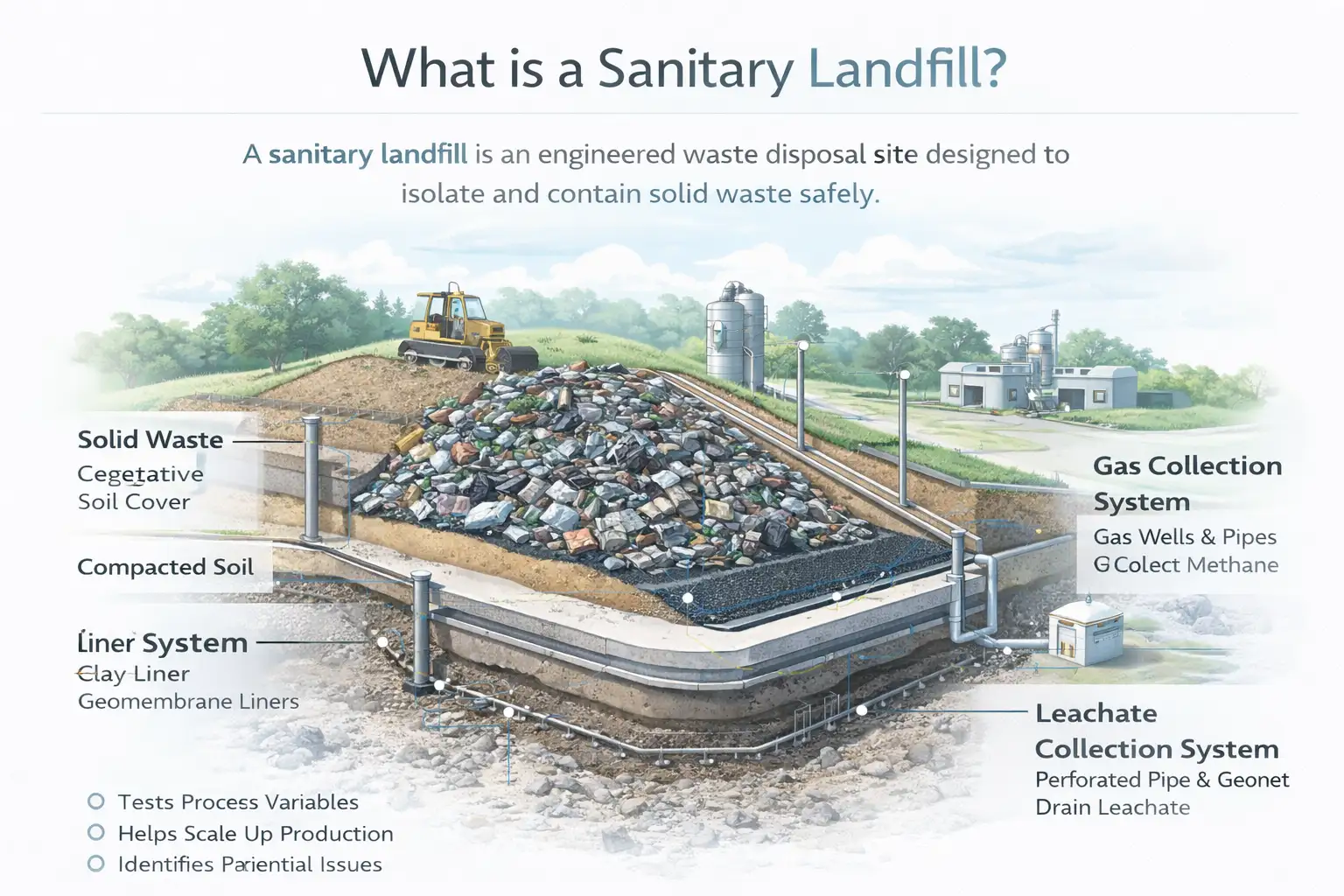
Before we understand the solution, we must first dive deeper into the challenge.
A landfill is a structure built on or into the ground for waste disposal. It has built-in safeguards to protect against any public health or safety hazards during this process.
The more advanced counterpart to landfills is the sanitary landfill. This is a specific site that uses engineering techniques to confine the waste to the smallest possible area. It also covers waste with a layer of earth every day.
Using a sanitary landfill prevents any rodents from entering the waste. It also minimizes odors and litter. Lastly, these landfills are designed to protect the soil and groundwater beneath them for decades to come.
What is the Need for Leachate Control?
As the rain pours down, water flows down the layers of waste. It collects chemicals and other harmful elements of the waste. This water, which contains harmful elements developed during this process, is called ‘leachate’.
If this leachate is not managed, it may seep into our groundwater, posing serious environmental hazards. For this reason, sanitary landfills use advanced drainage systems.
Such systems collect this leachate from the bottom part of the landfill. Using pipes, it diverts this toxic liquid away from the landfill to treatment facilities.
While traditionally gravel and sand were used to make this drainage layer, times have changed. Now, geosynthetics for landfills are used as a modern alternative.
These genonets are cheaper, significantly more effective, and easier to install.
How is Geonet for Landfill Drainage Useful?
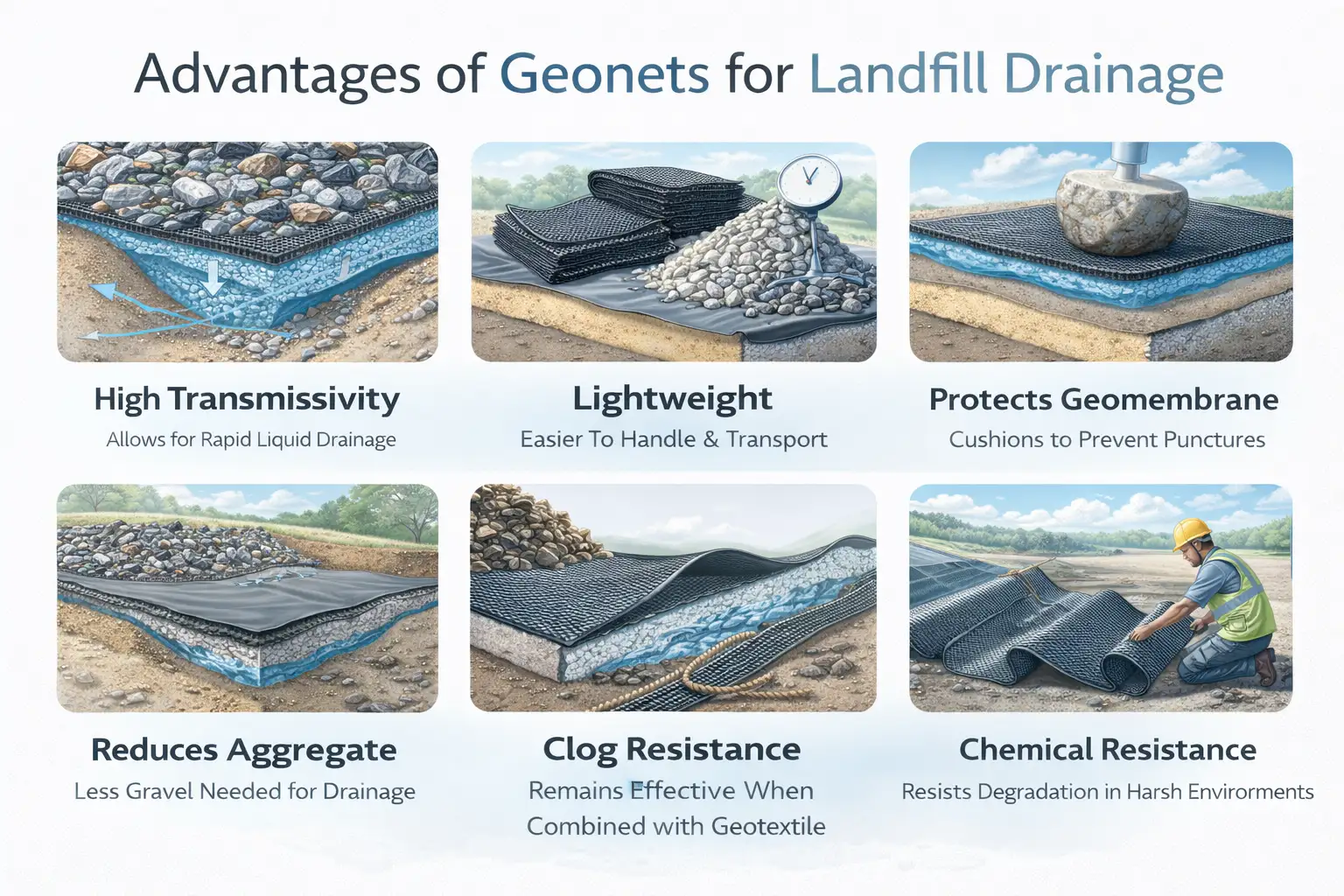
Geonet is a thick grid made of high-density polyethylene (HDPE). It has a maze-like channel structure that helps liquids and gases flow through the geonet.
Many geonet manufacturers also provide solutions laminated with geotextile fabrics. This turns a simple geonet into a ‘geocomposite’. In it, the geotextile acts as a filter, allowing only water to pass through. Any soil or fine particles are kept away to avoid drainage clogs.
Key Benefits of Geonets
Here are three of the best benefits of Geonets:
Space Savings
Geonets are usually just 5-8mm thick. But their hydraulic capacity and strength are comparable to those of much thicker gravel layers.
For landfills, this saves valuable airspace while delivering consistent results.
Consistent Performance
Geonets provide a predictable flow rate regardless of slope length. This leads to more consistent performance and better durability.
Easier Installation
Geonets come in light rolls that can be easily deployed on site. This leads to labor cost savings and eliminates the need to haul stone or gravel.
Role of Geonets in Landfill Capping
While bottom liners are crucial for sanitary landfills, the top is just as important. Once a section of the landfill is full, it needs to be closed off. This process is called landfill capping.
The main reason for a landfill cap is to reduce the likelihood of water entering the landfill and creating more leachate. To support this, a geocomposite drainage layer helps efficiently channel water away. These systems are often integrated with drainage geocomposite solutions to improve water flow and filtration efficiency further. It also protects the environment against harmful toxic gases.
A typical capped landfill has multiple layers. These include:
- A barrier layer to keep water out
- A drainage layer to shed rainfall
Geocomposites are also used to make these caps. They are able to efficiently protect the landfill against water seeping through or gases getting out.
Comparing Traditional Cap vs. Geocomposite Cap
Here is how a geocomposite landfill cap compares against a traditional soil drain:
Feature | Traditional Granular Drain | Geonet/Geocomposite Drain |
Material | Sand and gravel | HDPE Geonet + Geotextile |
Thickness | 12 inches (300mm) or more | 0.2 – 0.3 inches (5-8mm) |
Weight | Heavy: increases the load on waste | Lightweight; reduces settlement stress |
Installation | Slow; requires heavy equipment | Fast, simple roll placement |
Airspace Loss | High (reduces waste capacity) | Minimal (preserves capacity) |
Conclusion
Today’s modern advantages of geosynthetic solutions have made traditional landfills completely outdated. Gone are the days of simply digging a hole and burying our trash. Now, sanitary landfills are used to protect the environment from our waste disposal.
At the heart of this expert protection lies Geonets and their advanced capabilities. Whether it’s collecting leachate or shedding rainwater, a geonet for landfill drainage is a superior solution. It is efficient, cost-effective, and incredibly reliable.
That being said, you also need a reliable supplier of geonets as well to ensure maximum effectiveness. When it comes to quality and reliability, nobody does the job better than Indonet.
Indonet is a trusted manufacturer of advanced plastic netting and geosynthetics for landfills. It is known across global industries for being a reliable and trusted supplier.
Their innovative designs continue to push the capabilities of geosynthetics to new horizons.
For efficient and sustainable landfill drainage systems, look no further than Indonet. They are a coveted partner offering the support and expert guidance you will require for your next project.
Contact Indonet today and partner up with an expert dedicated to safeguarding our future through sanitary landfill geonets.
FAQs
1. What is a sanitary landfill?
A sanitary landfill is an engineered waste disposal site designed to protect the environment. It uses liners and drainage systems to contain waste and safely manage leachate.
2. How does the geonet for landfill drainage work?
Geonet for landfill drainage features a channeled core that quickly directs leachate to collection points. It replaces thick gravel layers, saving valuable space.
3. What is landfill capping?
Landfill capping is the final cover system placed over a completed landfill. This landfill cap prevents rainwater from entering and helps control gas emissions.
4. Why use geosynthetics for landfill applications?
Geosynthetics for landfill designs are thinner, stronger, and install faster than soil. They improve the efficiency of the entire landfill drainage system.
5. Is a capped landfill safe?
Yes, a properly capped landfill is safe. The landfill cap is engineered to permanently isolate waste, allowing the land to be repurposed as green space.