|
Getting your Trinity Audio player ready... |
Table of Contents
- 1 Quick Summary
- 2 Introduction
- 3 What is Soil Stabilization?
- 4 Why This Decision Decides the Project?
- 5 Types of Soil Stabilization Methods
- 6 How to Choose the Right Method?
- 7 Pavement Stabilization Applications by Road Category
- 8 Cost Drivers Nobody Warns You About
- 9 Conclusion
- 10 Frequently Asked Questions
- 10.1 1. What are the main methods of soil stabilization used on road projects?
- 10.2 2. Which soil stabilization method works best for weak subgrade?
- 10.3 3. How much does soil stabilization actually cost per square meter?
- 10.4 4. Can geosynthetics replace chemical stabilization entirely?
- 10.5 5. How long does a properly stabilized road layer last?
- 10.6 6. Is soil stabilization the same as ground improvement?
Quick Summary
For most road and highway projects, the best soil stabilization methods are:
- Lime or cement treatment for clay-heavy subgrades.
- Geocell confinement for soft ground.
- Geogrid reinforcement where load spreading is crucial.
Which one you pick depends entirely on the soil report, not on what a supplier tells you.
What this guide covers:
- Six methods I’ve actually specified on jobs (and two I avoid)
- How to read a soil report and match it to a method
- What CBR improvements are realistic vs. marketing claims
- Where geocells and geogrids earn their cost
- The cost drivers nobody mentions until the invoice arrives
- A few opinions that might annoy consultants
Introduction
The worst subgrade failure I ever inspected was a 14-kilometer stretch in coastal Saurashtra. Six lanes, brand new, lifted 55 millimeters after the second monsoon. The contractor had value-engineered out the lime treatment to save around 6% on material cost. The repair bill was eleven times that saving.
That’s the thing about soil stabilization. It’s the cheapest line item to cut during tendering and the most expensive one to skip.
I’ve been walking Indian road sites since around 1998, back when geosynthetics were considered exotic, and most rural roads went in with compaction and prayer. A lot has changed. Some of it is genuine progress, some of it is consultants copying old templates, and some of it is marketing dressed up as engineering.
This guide is my honest take. I’ll walk through the methods I trust, the ones I’m skeptical of, and how I actually decide which to use on a project.
What is Soil Stabilization?
Soil stabilization is the process of improving the engineering properties of soil, mainly its strength, stiffness, and durability, so it can carry traffic loads without failing. In road work specifically, this means treating the subgrade or subbase so the pavement above doesn’t crack, rut, or shove over its design life.
People often confuse it with ground improvement techniques, which is the broader parent category covering deep methods like stone columns, vibro-compaction, and preloading. Stabilization is the shallow cousin – the top meter or two of soil that supports the pavement structure.
At a glance
Property | Untreated Weak Soil | Stabilized |
|---|---|---|
CBR (soft clay) | 2-3% | 15-30% |
UCS after 7 days | <0.2 MPa | 0.7-1.5 MPa with cement |
Plasticity index | often 25+ | Cut to under 12 |
Realistic pavement life | 5-8 years | 15-25 years |
Those numbers aren’t theoretical. I’ve pulled them from actual QA test reports on projects I worked on.
Why This Decision Decides the Project?
Here’s something most tender documents don’t emphasize strongly enough: the stabilization choice determines the maintenance budget for the next 20 years.
Get it right, and the overlay cycle is 10-12 years. Get it wrong, and you’re patching every monsoon. I watched one state highway in central India go through three full overlays in seven years because the subgrade was never properly treated. The cumulative cost ended up roughly 2.4x what a proper cement-stabilized base would have cost at construction.
Red flags that mean you cannot skip serious stabilization
- CBR values below 3 on the soaked test
- Plasticity index above 20 (black cotton territory)
- Water table within 1.5 meters of formation level
- Heavy commercial traffic, especially haul roads serving quarries or ports
- Sites where drainage design is compromised by right-of-way limits
If two or more of these apply, mechanical compaction alone won’t save you. You need chemical, geosynthetic, or both.
Types of Soil Stabilization Methods
Six methods matter in practice. I’ll rank them by how often I actually specify them on live projects, not by how textbooks list them.
Method | How It Works | Best Soil | Realistic CBR Gain | Cost Level |
|---|---|---|---|---|
Lime stabilization | Ion exchange plus slow pozzolanic bonding | Expansive clay, PI 15+ | 5x to 10x | Low-medium |
Geocell confinement | 3D cellular lateral restraint of infill | Soft subgrade, any fill type | 3x to 5x effective | Medium |
Cement stabilization | Hydration bonding, quick strength gain | Silty sand, low-PI clay | 6x to 12x | Medium |
PP and PET Geogrids | Tensile reinforcement, load distribution | Weak subgrade under base | 2x+ bearing capacity | Medium |
Mechanical compaction and blending | Physical densification | Sandy, granular soil | 2x to 3x | Low |
Fly ash or bitumen treatment | Pozzolanic or binding film | Silty, granular soil | 3x to 6x | Low-medium |
There are two methods I deliberately left off this list: electrochemical stabilization and thermal stabilization. Both exist in academic papers. I’ve never seen either specified on a real commercial project in 25 years. If a consultant suggests them, ask why.
Mechanical stabilization
The oldest method on the list. It still works when done right, which on Indian sites means 95-98% of modified Proctor density with controlled moisture content. Compaction alone can lift CBR from 4 to 10 on decent silty sand.
The honest limitation: it can’t fix plasticity. You can compact black cotton soil to perfect density, and it’ll still swell 8-10% by volume when the monsoon hits. Mechanical methods press a problem down. They don’t change it.
Chemical stabilization: lime, cement, and the rest
Chemical treatment actually changes soil behavior. For high-PI clays (PI above 15), lime is my default. For low-PI silts and silty sands, cement wins because it cures faster and hits higher strength.
A quick note on dosage. Most Indian specs still default to 4-6% lime or 4-8% cement, but the real number depends on laboratory design mix testing, which is often skipped. I’ve seen projects where the specified 5% cement was actually over-dosed by 2% because nobody ran a proper dosage optimization. That’s wasted money and brittler pavement.
Additive | Typical Dosage | Best Application | Cure Time |
|---|---|---|---|
Hydrated lime | 3-8% by dry weight | Expansive clay, high PI | 7-28 days |
OPC 43 or 53 grade | 3-10% by dry weight | Silty sand, low-PI soil | 7 days |
Class C fly ash | 10-15% by dry weight | Silty, marginal soils | 7-14 days |
Bitumen emulsion | 4-7% by weight | Sandy, dry-climate subgrade | 1-3 days |
Lime-fly ash combo | 4% lime + 15% fly ash | Black cotton soil | 14-28 days |
The lime-fly ash combination deserves more attention than it gets. It’s cheaper than cement, gentler on plastic clays than pure lime, and quite forgiving on construction tolerances. I’ve used it on at least a dozen PMGSY projects with good long-term results.
Geosynthetic-based soil reinforcement methods
This is where the field has genuinely changed in my career. A 150mm Geocell layer filled with local aggregate can cut granular subbase thickness by 30-50% on soft subgrade. On a 20-km alignment that saves enough material haulage cost to fund the geocell itself, with change left over.
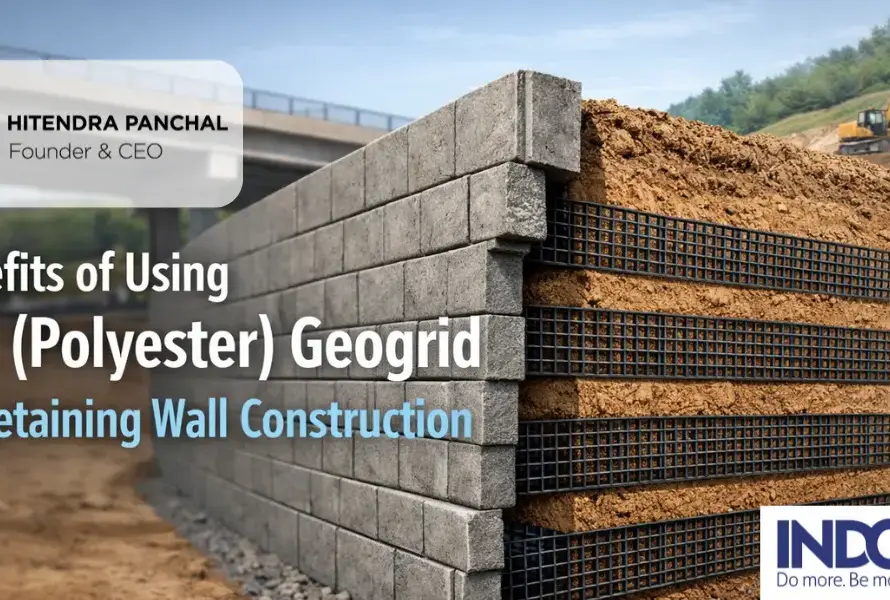
Geogrids are different animals. A PP Geogrid placed at the subgrade-subbase interface forces loads to distribute across a wider footprint, which drops stress on the subgrade. For taller embankments or reinforced soil walls where long-term creep matters, a PET Geogrid is almost always the right call because PET’s creep strain is much lower than PP over a 50-year horizon.
Geosynthetic | Primary Function | Best Road Application |
|---|---|---|
Geocell | 3D confinement of infill | Soft subgrade, haul roads, embankment slope protection |
PP Geogrid | Base and subbase reinforcement | Flexible pavements, low-cost rural roads |
PET Geogrid | Tensile reinforcement with low creep | Embankments, reinforced walls, stabilization of soil for long-life pavements |
Woven geotextile | Separation and filtration | Subgrade over soft clay or silty ground |
Pro tip: On very soft subgrade (CBR under 2), pair a woven separation geotextile BELOW a geocell layer. Separation keeps subgrade fines from migrating up into the aggregate. Confinement stops the aggregate from punching down. The combined system outperforms either component alone, and costs maybe 15% more than geocell on its own.
How to Choose the Right Method?
Most blogs skip this. They list methods and leave you to guess. Here’s how I actually decide on site.
Start with the soil report
If there’s no proper soil investigation with gradation, Atterberg limits, natural moisture, MDD, OMC, and soaked CBR at multiple depths, stop. Don’t pick a method yet. Get the investigation done. Guessing costs more than testing, every single time.
Match method to soil chemistry
This is the part junior engineers get wrong. Lime works on clay because clay has the reactive alumina-silicate chemistry for the pozzolanic reaction. Throw lime at silty sand and you’ve just wasted money on a soil that won’t react properly. Cement is the opposite: it prefers low-PI soils and doesn’t get along with high-organic or high-sulfate soils.
A quick screening rule I use: if PI is above 15, start with lime. If PI is below 10 with significant silt or fine sand content, start with cement. If PI is between 10 and 15, run both trial mixes and compare. Don’t just pick one.
Factor in traffic
A PMGSY village road with 40-60 commercial vehicles per day is a different problem than an NH expansion, seeing 8,000+. Higher traffic means you can justify more expensive ground improvement techniques because the cost-per-vehicle-kilometer drops.
Respect the climate
Monsoon-heavy regions punish poorly drained stabilized layers. Lime-treated clay, in particular, loses strength if it sits in standing water before full cure. On projects in the Konkan belt or northeast India, I always add a drainage detail review to the stabilization decision. Elsewhere, it might be automatic; in high-rainfall zones, it’s critical.
Site Condition | What I’d Specify |
|---|---|
Black cotton soil, NH or SH project | Lime-fly ash subgrade + PET geogrid at base |
Soft silty clay, district road | Cement stabilization or geocell |
Very soft organic/peaty ground | Geocell + woven geotextile separator |
Dry granular subgrade | Mechanical compaction + bitumen emulsion seal |
Expansive soil, low-budget rural road | Lime stabilization alone, 5% dosage |
Embankment over soft clay | PET geogrid + basal drainage |
Pavement Stabilization Applications by Road Category
Different road classes need different answers. The table below reflects what actually shows up in IRC-compliant designs I’ve reviewed, not what a textbook might suggest.
Road Type | Typical Stabilization Strategy |
|---|---|
National highways, expressways | Cement-treated base + PET geogrid |
State highways | Lime or cement subgrade + PP geogrid |
District and village roads | Lime stabilization or geocell, depending on the soil |
Haul and port access roads | Geocell with local infill |
Airport taxiways, aprons | Cement-treated subbase + geogrid |
Railway formations | Geocell or geogrid over soft subgrade |
For more on geocell for road construction, the design variables that actually matter are cell depth, weld strength, and infill gradation. Get those three right and the system works. There’s a broader walkthrough of the full stabilization of soil approach that ties the method choices together.
Cost Drivers Nobody Warns You About
Clients always want a rupees-per-square-meter number. I refuse to give one without seeing the soil report, and here’s why.
Cost Driver | Real Impact on Project Cost |
|---|---|
Binder dosage (1% variation) | Can swing material cost 15-20% on chemical methods |
Haul distance to site | Rural projects 200km+ from plant see delivery cost double |
Cure time on critical path | Each week of delay = indirect cost of 0.5-1% of project |
QC testing regime | High-spec projects need 3-4x the lab work of minimum-spec |
Specialized equipment rental | Reclaimers and stabilizers cost 2-3x graders per day |
Geosynthetic grade selection | PET costs 30-60% more than PP but lasts 3-5x longer |
The hidden one: specification conservatism. Consultants often over-specify binder dosage by 1-2% to cover themselves against weak QC. On a 50-km project, that “safety margin” can cost 8-12 crore in unnecessary cement.
Conclusion
Twenty-five years of specifying these methods on live projects has taught me a few things worth passing on.
The first is that no single method wins every time. Anyone who tells you otherwise is selling something. The right answer comes from the soil report, the traffic spec, the climate, and honestly the contractor’s competence. I’ve seen cement stabilization fail because QC was loose, and I’ve seen basic compaction succeed because the crew was meticulous.
Combined systems almost always outperform single-method solutions. A lime-treated subgrade with a PP geogrid at the base-subbase interface is more forgiving than either element alone. It’s also more forgiving than a purely cement-treated design of the same cost, which is why I lean toward composites on projects with budget constraints.
The last point is uncomfortable but worth saying: construction quality decides whether any of this works. A perfect design with poor compaction control, skipped cure times, or wrinkled geogrids will fail. A conservative design, built carefully, will outlast everyone’s expectations.
For material specifications and technical support on your next project, a well-placed Geocell or geogrid system still anchors most of the long-life pavement designs I trust. Indonet Group supplies PP geogrids, PET geogrids, and geocells that meet IRC and MORTH requirements, which matters more than people realize when technical bid scrutiny starts.
Frequently Asked Questions
1. What are the main methods of soil stabilization used on road projects?
Six methods cover 95% of what gets used in practice: lime stabilization, cement stabilization, fly ash or bitumen treatment, mechanical compaction, geocell confinement, and geogrid reinforcement. Most modern highway projects combine two or three of these rather than relying on one.
2. Which soil stabilization method works best for weak subgrade?
Honestly, depends on how weak. CBR between 3-5 responds well to lime or cement alone. CBR under 3 usually needs a geocell or geogrid layer combined with chemical treatment above. CBR under 2 almost always needs a geocell plus separation geotextile plus chemical treatment in the layer above.
3. How much does soil stabilization actually cost per square meter?
Without a soil report this question can’t be answered honestly. Ballpark numbers: mechanical methods run 80-150 per sqm, lime treatment 200-400, cement treatment 300-600, and geocell systems 400-800 depending on depth and infill. Those are rough 2024-25 Indian rates and change with material prices.
4. Can geosynthetics replace chemical stabilization entirely?
Sometimes, not always. Geosynthetics give mechanical improvement through reinforcement or confinement but they don’t change soil chemistry. For high-PI expansive clays, no amount of geogrid fixes the swelling problem. You still need lime or cement above the geosynthetic. On non-expansive soft soils, geosynthetic-only solutions can work beautifully.
5. How long does a properly stabilized road layer last?
Well-designed stabilized layers routinely last 15-25 years under design traffic. Geogrids and geocells have material design lives of 100+ years, so they usually outlast the pavement sitting on them. Failures almost always trace to poor construction QC, not material degradation.
6. Is soil stabilization the same as ground improvement?
They overlap but aren’t identical. Soil stabilization typically refers to shallow treatment of subgrade and subbase for pavement support. Ground improvement is broader and covers deeper methods like stone columns, sand drains, and preloading for building foundations or tall embankments. For roads, stabilization is the relevant parent term; for large structures, ground improvement is.

Hitendra Panchal
Founder & CEOMr. Panchal is on a mission to revolutionize India's plastics landscape. Under his leadership, Indonet delivers essential solutions that fortify infrastructure, construction, and agriculture projects. Since 2007, he has built a manufacturing powerhouse specializing in high-performance geosynthetics and extruded netting.A champion of the "Make in India" initiative, he drives sustainable innovation to build resilient supply chains. Mr. Panchal empowers businesses to enhance project integrity and long-term value through world-class, engineered plastic solutions trusted globally.