|
Getting your Trinity Audio player ready... |
Table of Contents
- 1 What a Green Roof System Is and How It Works
- 2 Extensive Green Roof or Intensive: Which One Fits
- 3 Green Roof Benefits and Limitations
- 4 Green Roof Layers, Bottom to Top
- 5 The Green Roof Drainage Layer
- 6 The Filter Layer Over the Drain
- 7 Green Roof Construction, Step by Step
- 8 Roof Garden Drainage on Podium and Flat Decks
- 9 Getting a Green Roof to Last
- 10 Frequently Asked Questions
- 10.1 1. What is a green roof and how does it work?
- 10.2 2. What are the layers of a green roof system?
- 10.3 3. What is the green roof drainage layer for?
- 10.4 4. What is the difference between an extensive and an intensive green roof?
- 10.5 5. Do green roofs leak?
- 10.6 6. What are the main benefits of a green roof?
Ask most people, and a green roof is just soil and some plants on a slab. It isn’t. The real work happens lower down, in a few thin layers over the waterproofing, a root barrier, a drainage layer, a filter, then the growing medium and the planting. Get the drain and the filter right, and it stays dry below, green on top, for thirty-odd years. Get them wrong, and the water either sits on the deck or carries the soil off into the outlets. What follows takes the green roof layers in turn, the green roof drainage layer and filter that carry the load, the construction sequence, when an extensive green roof wins over the heavier sort, the green roof benefits that pay their way, and roof garden drainage on a podium deck.
Most roof leaks under a garden don’t start with the plants. They begin lower down, at the point where the water got trapped and had no way out.
A green roof is really a water-handling job. Rain comes down on the planting, filters through the soil, and then it has to get off the slab, no drowned roots, no puddle sitting on the membrane.
That whole job belongs to two thin layers near the bottom. The drain, and the filter over it.
Both of those come out of our own plant at Indonet, the geocomposite drain and the nonwoven filter. So I’m coming at this from the supply side. What each layer actually does, and the quiet ways a green roof lets you down.
What a Green Roof System Is and How It Works
Lift the soil and planting away and a green roof system is pretty ordinary underneath, a waterproofed slab, then a drain and a filter stacked on it, arranged so water clears off fast and the roof below keeps dry. The planting is the part you see. The engineering is everything under it.
Rain wets the planting, and the growing medium keeps some of it back for the roots. The rest sinks to the drainage layer, works across to the outlets, and goes. In between the soil and the drain sits a filter, so the two stay apart.
The Job Each Layer Shares
Every layer is really answering one question. Where does the water go next?
Soil holds a little and passes the rest. The drain gets rid of it.
The filter keeps the soil off the drain so it runs clear. Drop any one of those links and the whole lot fails at that point.
Extensive Green Roof or Intensive: Which One Fits
An extensive green roof is the shallow, light, leave-it-alone sort; go intensive instead and you’re into deep soil, real weight, and a garden you’d actually walk around in. What the structure can bear tends to make the call here, not the look you’re after.
Feature | Extensive green roof | Intensive green roof |
|---|---|---|
Soil depth | 50 to 150 mm | 200 mm and up |
Weight (saturated) | Light, 60 to 150 kg/m² | Heavy, 300 kg/m² and up |
Planting | Sedum, grasses, moss | Shrubs, lawns, small trees |
Upkeep | Low, once or twice a year | High, like any garden |
Access | Usually none | Designed for people |
Weight Is the Deciding Line
Here’s the thing people get backwards. The structure comes first, then the roof type, not the other way round.
An extensive green roof drops onto a lot of existing buildings because it’s so light. An intensive one usually needs the slab designed for it from the start. Load the roof it can’t carry and no drainage layer on earth will save you.
Green Roof Benefits and Limitations
The green roof benefits aren’t soft claims, they turn up where you can measure them, in stormwater that never reaches the drain, a building that runs cooler under the soil, a membrane that lasts longer out of the sun, and a bit of green where the bitumen used to bake. None of it lands for free, mind.
The soil and planting swallow a fair bit of every storm, so the drains get less at once. That layer insulates too, and the floor under it runs cooler come summer. And the membrane, shaded and spared the daily heat swing, usually outlasts a bare one by years.
Where a Green Roof Struggles
The limits sit mostly at the start. The build-up puts weight on the structure it has to hold, and the first cost beats a plain roof. Worse, the waterproofing has to be right straight away, since reaching it later means pulling the whole garden off.
That last point is the quiet one. A leak under a green roof is slow and expensive to chase. Which is exactly why the layers below the soil earn their keep.
Green Roof Layers, Bottom to Top
A green roof goes down in one fixed order, bottom to top, and that order is really the whole design. Shuffle the sequence and water ends up somewhere it has no business being.
Layer | Material | Job |
|---|---|---|
Waterproofing | Membrane on the slab | Keeps water out of the building |
Root barrier | Tough sheet or treated fabric | Stops roots reaching the membrane |
Drainage | Geocomposite or dimpled board | Carries water to the outlets |
Filter | Nonwoven geotextile | Keeps soil out of the drain |
Growing medium | Light mineral and compost mix | Holds water, feeds the plants |
Planting | Sedum, grass, or shrubs | The green part |
The waterproofing is where it all rests, and in India it’s laid to IS 3067 for building waterproofing. Above it, a root barrier stops the planting chewing into the membrane. Some membranes have the deterrent built in, but a separate layer is cheap insurance.
Why the Order Can’t Change
The order follows the water. It drops through the plants, down through the soil, past the filter, into the drain, and out.
Put the filter below the drain, or lay soil straight on the membrane, and the path just jams. The stack only holds together read top to bottom, the way the rain really moves.
The Green Roof Drainage Layer
Of every layer in the stack, the green roof drainage layer is what decides whether water leaves or just sits there, and a bonded geocomposite drain is how it’s done now. It takes over from the old gravel bed that used to do the job.
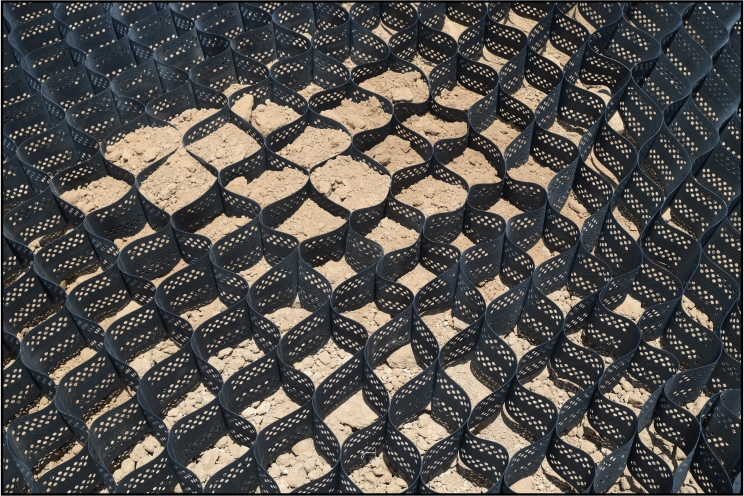
A geocomposite drain is basically a stiff plastic core, hollow and full of channels, with filter fabric welded over the top. That core keeps the gap open that moves the water sideways. The bonded fabric keeps the soil out.
Our INDODRAIN Geocomposite is built exactly for this, a drainage core married to a geotextile in one sheet, so it drains and filters together.
Drainage option | Weight | Flow | Filter |
|---|---|---|---|
Gravel bed | Heavy | Less predictable | Separate layer needed |
Geocomposite drain | Light | Tested, consistent | Built in |
Drain Board or Dimpled Sheet
Two shapes do this job. Either a flat geocomposite drain, or a dimpled board, whichever suits the roof and the load it carries.
The dimpled kind is formed into hard cups that hold an air gap, pass water, and take weight. Some hold a little rain back in the cups as well, for the plants to use later.
Both move the water. The pick is really about soil depth and the traffic above.
The Filter Layer Over the Drain
Between the soil and the drain sits a nonwoven geotextile filter, and it’s this thin layer that keeps the whole roof from silting shut. Small layer. It sets how long the roof lives.
Soil is full of fine particles. Leave the filter out and every storm drives them down into the drain core, where they settle in the channels and slowly throttle it from inside. A nonwoven sheet passes the water and holds the fines back up in the soil where they belong.
Why the Geotextile Can’t Be Skipped
The pores have to be judged right. Too tight and water backs up on the deck. Too open and the fines pour straight through.
A needle-punched nonwoven like our INDODRAIN Geotextile is matched to the growing medium so it filters without blinding over. Leave it out to save a few rupees a square metre, and the drain you paid good money for clogs inside a season or two.
Green Roof Construction, Step by Step
Green roof construction runs in the order of the layers, and the step that gets rushed most is checking the waterproofing before anything goes on top of it. Once the garden’s down, that membrane is buried.
The slab is waterproofed first and flood-tested, held under water for a day or two to prove it’s tight. Then the root barrier, then the drainage layer laid out across the roof, lapped and run to every outlet. The filter goes over the drain, the growing medium over the filter, and the planting last.
Step | Layer | What to check |
|---|---|---|
1 | Waterproofing | Flood-test before you cover it |
2 | Root barrier | Full coverage, lapped joints |
3 | Drainage | Clear path to every outlet |
4 | Filter | No gaps, no tears |
5 | Growing medium | Even depth, right mix |
6 | Planting | Suited to the soil depth |
The Steps That Get Rushed
Two steps cost the most when they’re hurried. The flood test, and the run to the outlets.
Skip the flood test and a pinhole leak only shows up once the whole garden’s on top of it. Choke the route to an outlet and the water has only one way left, upward, into the soil, drowning the very roots it was there to serve.
Roof Garden Drainage on Podium and Flat Decks
Roof garden drainage on a podium or a flat terrace deck is the same job one floor lower, with a heavier garden sitting over rooms people actually use. The deck has to throw off water and guard the waterproofing under the whole load.
A podium deck takes more load than a thin green roof, so here the drainage layer pulls double duty and shields the membrane while the build goes on. A sturdy dimpled board covers both jobs together. Our Indokon Dimple Board shields the waterproofing from the backfill and the traffic while it carries water across to the outlets.
Falls, Outlets, and Ponding
A flat deck is never truly flat. It’s laid to a slight fall, so water drifts toward the outlets instead of parking in the middle.
Ponding is the enemy on a deck. Standing water hunts out the smallest fault in the membrane and keeps picking at it. A drainage layer and a steady fall together keep it moving, and a moving film is what leaves the deck dry underneath.
Getting a Green Roof to Last
A green roof really turns on three decisions, and all of them come early. Prove the waterproofing before a thing goes over it, size the drainage layer to the rainfall it’ll see, and match the filter to the soil on site. Those three carry the garden above them.
We ship into these builds, so we see what comes back. The failures rhyme.
No filter, and the drain silts up. A buried leak nobody flood-tested for. A deck with no fall, ponding in the low spots.
None of those are plant problems. They’re layer problems, settled long before the first sedum went in.
The Two Layers Never to Cut
When the budget tightens, the drain and the filter are the last two things to touch. They’re thin lines against the structure, the soil, and the planting.
Cut them, and the saving turns into a lifted garden and a chased leak a few years on. The cheapest layers on the roof are the ones holding the whole thing together.
Frequently Asked Questions
1. What is a green roof and how does it work?
A green roof works in layers over the waterproofing. Rain soaks into the soil, the extra drops into the drainage layer below, and that runs it off to the outlets. The soil holds some back for the plants, and a filter keeps it from washing into the drain.
2. What are the layers of a green roof system?
Working up from the slab, you’ve got the waterproofing first, then a root barrier, the drainage layer, a filter geotextile, the growing medium, and the planting on top. Each one does a single job, and the order just follows the path the water takes down through the roof.
3. What is the green roof drainage layer for?
It carries the spare water sideways to the roof outlets, so nothing ponds on the deck or drowns the roots. Most jobs use a geocomposite drain for it, a plastic core with a bonded filter, because it’s light and its flow rate is tested rather than guessed.
4. What is the difference between an extensive and an intensive green roof?
An extensive one stays thin and light, planted with sedum or grasses, and asks for little upkeep. Go intensive and it’s deep and heavy, planted like a real garden with shrubs or small trees, and the structure has to be built to carry that weight.
5. Do green roofs leak?
A well-built one doesn’t, because the waterproofing is flood-tested before the layers go on. Most green roof leaks trace back to waterproofing that was never proven, or a drainage path that let water pond on the deck instead of leaving.
6. What are the main benefits of a green roof?
You get less stormwater runoff, a cooler building underneath, a longer life out of the roof membrane, and a patch of green in a built-up spot. Against that sit the extra weight and the higher cost at the start.

Hitendra Panchal
Founder & CEOMr. Panchal is on a mission to revolutionize India's plastics landscape. Under his leadership, Indonet delivers essential solutions that fortify infrastructure, construction, and agriculture projects. Since 2007, he has built a manufacturing powerhouse specializing in high-performance geosynthetics and extruded netting.A champion of the "Make in India" initiative, he drives sustainable innovation to build resilient supply chains. Mr. Panchal empowers businesses to enhance project integrity and long-term value through world-class, engineered plastic solutions trusted globally.