|
Getting your Trinity Audio player ready...
|
Table of Contents
- 1 Overview
- 2 What are Geotextiles?
- 3 What are Geocells?
- 4 When to Use Geocells and Geotextiles
- 5 FAQs
- 5.1 1. How do I choose between geocells and geotextiles for soil stabilization?
- 5.2 2. Which is better for road construction projects, geocells or geotextiles?
- 5.3 3. When should I use geocells instead of geotextiles for erosion control?
- 5.4 4. What should I consider when choosing geosynthetic materials for a slope?
- 5.5 5. Can I use geocells and geotextiles together on one project?
Overview
Here’s a quick summary of the key features of geotextiles and geocells:
Geotextiles:
- Flexible cloth-like sheets
- Used for separation and filtration
- Applied in drainage, soil separation, and erosion control.
Geocells:
- Rigid three-dimensional honeycomb structure
- Used for confining and reinforcement
- Applied for heavy load support and slope stabilization
In this blog, I will break down their definitions, use cases, and when you should use each solution in your industry.
________________________________________________________________________________
Need to decide between using geotextiles or geocells for your project?
If so, I’m glad you are here!
These two critical geosynthetic materials are often confused with each other, and sometimes even lead to costly misapplications.
In this blog, I’m going to break down their technical definition, key benefits, and common applications, helping you better understand the broader applications of geosynthetics in modern construction and infrastructure projects.
(If you’re in a hurry, you can skip right to the table of features and applications of each solution!)
Let’s get started.
What are Geotextiles?
Geotextiles are permeable synthetic fabrics made from polymers (typically polypropylene or polyester).
If you’re wondering what is geotextile fabric, it refers to these engineered materials designed for soil-related applications.
They are primarily used in conjunction with soil to separate, filter, reinforce, protect, or drain water, excess fertilisers, or other harmful liquid materials.
You can think of them as the versatile, all-purpose textiles of the geosynthetics family.
Their main function is to separate soil layers and allow water to pass through without any soil loss, sliding, shifting, or erosion.
Key Characteristics of Geotextiles
- Form: Flexible (cloth-like sheets); they can be woven or non-woven.
- Primary Function: Separation, Filtration, and Drainage.
- Material: Typically made from polypropylene or polyester, offering excellent durability and chemical resistance.
- Key Advantage: Their permeability makes them ideal for managing water flow within soil structures while preventing the mixing of different soil layers.
Common Applications of Geotextiles
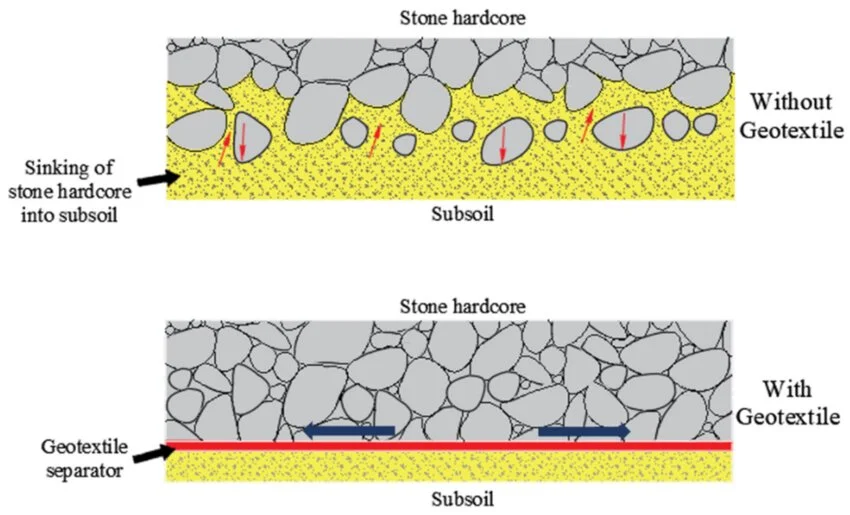
Source: https://www.researchgate.net/figure/Separation-function-of-geotextiles_fig2_340603684
Geotextiles have four major applications across different industries:
- Road Construction: Geotextile layers are often placed between the subgrade and the aggregate base to prevent mixing and extend the road’s lifespan.
- Drainage Systems: When wrapped around pipes or installed in trenches, geotextiles can help filter soil particles and direct water flow to dedicated outlets.
- Erosion Control: One of the most important applications of geotextiles is in stabilizing soil on slopes and under riprap to prevent surface erosion.
- Landfills: Lastly, geotextiles serve as a protective and filtering layer in lining and cover systems. They can also shield impermeable geomembranes from punctures and prevent soil from clogging drainage layers.
What are Geocells?
Geocells are three-dimensional, honeycomb-like structures.
They are usually made from strips of polymeric materials (often HDPE) that are welded together.
When expanded and filled with soil, aggregate, or concrete, geocells form a rigid mattress-like structure that confines the infill material.
Their core function?
To provide robust mechanical stabilization and erosion control through three-dimensional confinement.
Let us explore what it looks like and how it is used.
Key Characteristics of Geocells
- Form: A 3D cellular network (resembles a web or honeycomb).
- Primary Function: Reinforcement and Erosion Control.
- Material: Commonly made from high-density polyethylene (HDPE), which is known for its strength and durability.
- Key Advantage: The 3D structure provides unparalleled lateral confinement, effectively turning infill materials into a cohesive, load-bearing platform.
Common Applications of Geocells
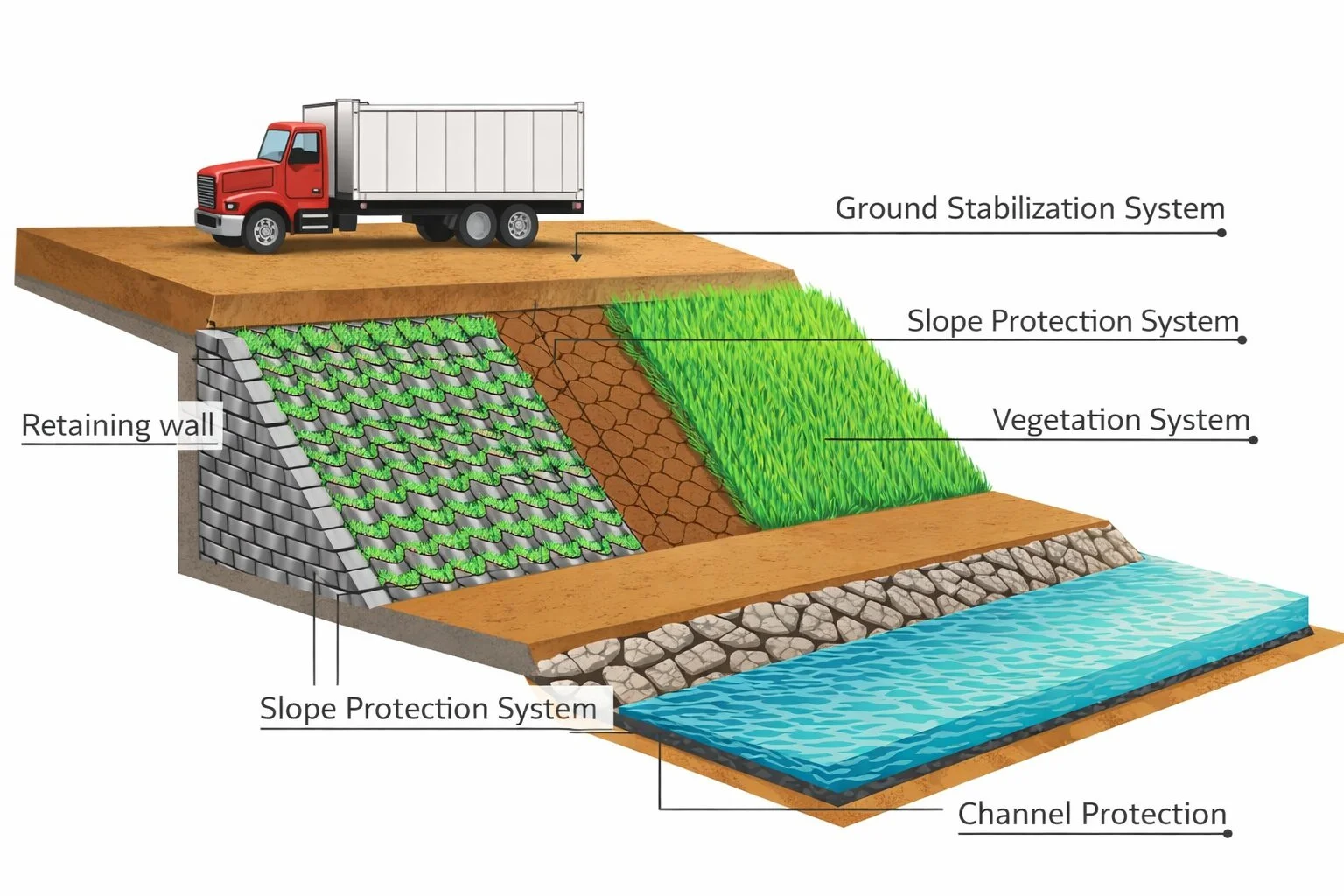
- Soil Stabilization on Weak Subgrades: Geocells create stable working platforms for roads, railways, and construction sites located/based on soft soil.
- Slope and Channel Protection: By confining vegetation or aggregate within their structure, geocells can prevent soil erosion on steep slopes and in drainage channels.
- Earth Retention Walls: Geocells are one of the most important materials for building cost-effective, vegetated retaining walls for landscaping and infrastructure.
- Load Support for Heavy Equipment: They can also help us distribute loads over a wider area to prevent rutting and failure.
When to Use Geocells and Geotextiles
Choosing between geotextiles and geosynthetics often comes down to the primary challenge your project faces.
Here’s a breakdown of the ideal scenarios for each of the two geosynthetic materials:
When to Use Geotextiles
I recommend going with geotextiles if you want a material for functions such as separation, filtration, or protection. The fabric-like nature of geotextiles makes them ideal for managing water and preventing soil mixing.
Let’s take a look at some common geotextile applications:
- Filtering soil particles in drainage systems.
- Protecting liners in ponds and landfills from puncture.
- Preventing erosion under riprap on slopes.
- Stabilizing subsoil for basic landscaping projects.
Geotextiles are also often used for separating soil bases beneath road surfaces.
The key advantage of geotextiles in road construction lies in their ability to extend the life of the road by preventing the base course from sinking into the soft subgrade.
When to Use Geocells
Choose geocell for soil stabilization when you need to create a strong, stable platform on weak ground or reinforce slopes against failure. Their 3D structure provides unmatched confinement and load distribution.
Typical geocell uses include:
- Stabilizing very soft subgrades for construction access.
- Reinforcing steep embankments and slopes.
- Building green retaining walls and channel linings.
- Creating durable load support for heavy equipment.
- Preventing soil erosion on challenging inclines.
For any significant project in South Asia, I suggest partnering with experienced geocell manufacturers in India. It will ensure that you get a product suited to local conditions.
Proper geocell installation is also crucial for unlocking the system’s full performance, creating a rigid mattress that distributes weight effectively.
Indonet: Your Reliable Supplier of Geotextiles and Geocells
Through this blog, I have walked you through the different scenarios where you can use geotextiles and geocells. We’ve explored their definitions and applications so that you can choose the right geosynthetic material for your requirements.
However, choosing the right geosynthetic is only half the battle.
The other half is sourcing high-quality materials from a trusted partner – that’s what ensures project success.
As a leading geosynthetics specialist and supplier in India, we at the Indonet Group provide comprehensive solutions for all your soil stabilization needs.
We offer a wide range of products, including Woven and Non-Woven Geotextiles for separation and filtration, as well as robust Geocells for heavy-duty reinforcement.
Let our technical expertise guide you to the optimal, cost-effective solution.
Connect with us at Indonet for durable materials and expert support, and we will help you with everything from selection to acquisition to installation of the best geosynthetic materials for your project!
FAQs
1. How do I choose between geocells and geotextiles for soil stabilization?
For soil stabilization, choose a geotextile when you need to separate soil layers or add some strength to a flat area. Choose a geocell when you need to build a stable platform on very soft or sloped ground, as its 3D structure provides superior confinement for gravel or soil.
2. Which is better for road construction projects, geocells or geotextiles?
For most road construction, a strong geotextile is often the primary choice to separate the subsoil from the gravel base, providing a key advantage in preventing rutting. A geocell is used for road construction on extremely soft ground where traditional methods would fail, creating a deep, stable foundation.
3. When should I use geocells instead of geotextiles for erosion control?
Use geocells for heavy-duty erosion control on steep slopes, channels, or shorelines where you need to build a permanent, vegetated structure. Use geotextiles for surface protection on gentler slopes to hold soil in place while seeds germinate.
4. What should I consider when choosing geosynthetic materials for a slope?
When choosing geosynthetic materials for a slope, consider the soil type and steepness. For stabilizing fill material on a newly built slope or wall, geocells are excellent. For protecting the surface of an existing slope from water erosion, a geotextile is typically the right choice.
5. Can I use geocells and geotextiles together on one project?
Yes, using both geocells and geotextiles together is a very effective strategy. A common application is to place a geotextile on the soil first for separation and filtration, then install a geocell on top and fill it with aggregate for high-strength reinforcement.