|
Getting your Trinity Audio player ready... |
Table of Contents
- 1 Top 7 Applications of Geosynthetics: Table of Contents
- 2 Best Applications of Geosynthetics
- 3 What are Geosynthetics?
- 4 The 7 Best Applications of Geosynthetics in 2026
- 5 Indonet: India’s Leading Geosynthetics Supplier
- 6 Geosynthetics Applications: FAQs
- 6.1 1. What are the most common uses of geosynthetics?
- 6.2 2. Why use geosynthetics in road construction?
- 6.3 3. How do geosynthetics for drainage work?
- 6.4 4. What should I consider when choosing geosynthetics manufacturers?
- 6.5 5. Are geosynthetics effective for erosion control?
- 6.6 6. What are the main applications of geosynthetics in civil engineering?
- 6.7 7. Which industries use geosynthetics the most?
- 6.8 8. What is the difference between geotextiles, geogrids, and geomembranes?
- 6.9 9. How do geosynthetics reduce construction cost?
- 6.10 10. Where can I source high-quality geosynthetics in India?
Quick Answer
Geosynthetics are used in seven main applications across construction and civil engineering: road construction, landfill containment, erosion control, drainage systems, retaining walls, railway stabilisation, and canal linings. In each application, geotextiles, geogrids, geomembranes, or geocomposites replace or enhance traditional materials such as concrete, gravel, or compacted clay – reducing cost, extending service life, and improving environmental outcomes.
Last updated: July 2026 · By Hitendra Panchal, Founder & CEO, Indonet Group
In this blog, we will explore the top 7 applications of geosynthetics in 2026:
- Road Construction
- Landfill Containment
- Erosion Control
- Drainage Systems
- Retaining Walls
- Railway Stabilisation
- Canal Linings
For each application, we’ve discussed the type of geosynthetics used, the primary functions they fulfil, and key benefits they offer vs. alternatives.
The world we live in is undergoing a silent revolution, beneath which lies the human-made material that is making it all possible – geosynthetics.
From the roads we drive on to the clean water we drink, these advanced polymer materials are changing the way in which we deal with age-old engineering challenges.
These unsung heroes – geosynthetics – are fast becoming critical to construction and environmental protection in 2026.
In this blog, we will explore and discuss the top 7 ways these engineering marvels are building a more stable, sustainable, and efficient future.
Let’s dive in!
This is the applications reference in our geosynthetics guide series. If you’re new to the topic, start with our foundational guide to what geosynthetics are. If you want to understand the different products in the geosynthetics family, see our guide to the types of geosynthetics. This page focuses specifically on where and how geosynthetics are used in the field – the seven sectors that account for the majority of global geosynthetics consumption.
Top 7 Applications of Geosynthetics: Table of Contents
- TL;DR: Best Applications of Geosynthetics
- What are Geosynthetics?
- The 7 Best Applications of Geosynthetics in 2026
- Geosynthetics Applications: FAQs
Best Applications of Geosynthetics
Here’s a quick table that shows the top industry applications of geosynthetics along with their key benefits vs. using alternatives:
| Application | Type of Geosynthetic Used | Primary Functions | Key Benefit vs. Alternatives |
| Road Construction | Geotextiles, Geogrids | Separation, Reinforcement, Stabilisation | Extends pavement life by 30%; reduces material use & maintenance costs. |
| Landfill Containment | Geomembranes, Geotextiles | Containment, Protection | Superior, reliable containment of contaminants vs. compacted clay liners. |
| Erosion Control | Geotextiles, Geobags, Geomats | Erosion Control, Filtration | Flexible, promotes vegetation growth; more effective & sustainable than concrete. |
| Drainage Systems | Geocomposites, Geonets | Drainage, Filtration | Lightweight, easy-to-install, and more efficient than gravel/pipe systems. |
| Retaining Walls | Geogrids, Geotextiles | Reinforcement, Stabilisation | Faster, more cost-effective, and offers greater design flexibility than concrete walls. |
| Railway Stabilisation | Geotextiles, Geogrids | Separation, Stabilisation | Reduces settlement and maintenance cycles for a safer, longer-lasting rail network. |
| Canal Linings | Geomembranes | Containment, Seepage Control | Superior water retention; more effective than crack-prone concrete or earth. |
What are Geosynthetics?
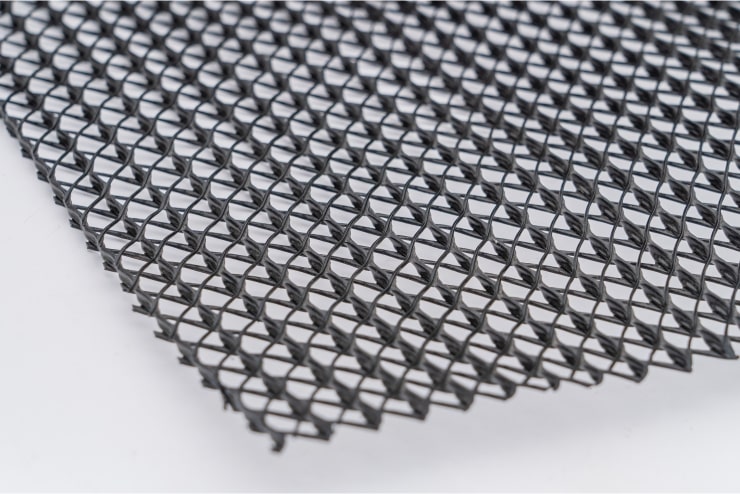
Geosynthetics are human-made materials that help us solve a range of surface- and ground-related engineering problems.
Think of them as high-tech fabrics and grids: they separate soil, reinforce weak ground, filter water, drain areas, or control erosion.
You can find them working behind the scenes in everything from the roads to landfills, making modern construction stronger, more cost-effective, and longer-lasting.
The 7 Best Applications of Geosynthetics in 2026
1. Road Construction & Highway Infrastructure
Industry: Transportation & Civil Engineering
Type of Geosynthetic Used: Geotextiles (Woven and Non-Woven), Geogrids
Functions: Separation, Reinforcement, Stabilisation, and Filtration
Geotextiles and geogrids are transforming the modern road construction industry. In fact, road construction accounts uses 50% of all geosynthetics produced annually around the world.
They provide separation, stabilisation, and reinforcement, thus creating a stable base that extends the life of a road surface.
Plus, they also prevent soil mixing to ensure that roads undergo minimal corrosion under heavy loads. They also prevent waterlogging by helping us create even surfaces.
Studies show that reinforced pavements can last up to 30% longer, reducing aggregate use and maintenance costs for superior long-term performance.
Road Construction: Road construction accounts for roughly 50% of global geosynthetics demand. India’s Ministry of Road Transport and Highways has increasingly specified geogrids and non-woven geotextiles for national highway projects under NHAI standards. Typical GSM range: 150-400 GSM for non-woven geotextile separation; PP biaxial geogrids at 30-40 kN/m for base reinforcement.
Benefits vs. Using Alternatives:
Since geosynthetics can extend road life and minimise maintenance, they can substantially reduce both the capital and recurring costs required to build highways. They also drastically reduce the cost that you might have to bear for aggregate material every time you need to repair a road.
2. Sustainable Landfill & Waste Containment
Industry: Environmental Protection & Waste Management
Type of Geosynthetic Used: Geomembranes, Geotextiles, Geocomposites
Functions: Containment, Protection, Drainage, and Filtration
Landfill and waste containment is one of the fastest-growing applications of geosynthetics.
While geomembranes act as impermeable barriers for leachate containment, geotextiles offer crucial puncture protection.
Together, they thus help us create a multi-layer system that safeguards groundwater from contaminants. They also offer a more consistent and secure performance than compacted clay liners alone.
This is quickly making geosynthetics one of the most important components of to modern waste management infrastructure.
Landfill Containment: Modern landfill liners typically use 1.5 mm to 2.5 mm HDPE geomembranes as the primary barrier, protected by non-woven geotextiles above and below. India’s Central Pollution Control Board (CPCB) guidelines require engineered liners for all new municipal solid waste landfills. Service life of a properly installed HDPE geomembrane system exceeds 30 years under typical
Benefits vs. Using Alternatives
The main benefit of using geosynthetics for landfill and waste containment is the superior quality of these polyester materials. They can last longer than other materials without requiring maintenance or frequent replacements. As a result, it is both cost-effective and efficient compared to alternatives. It will also indirectly reduce the burden on water filtration systems that you might have to use in case the groundwater becomes contaminated.
3. Coastal & Riverbank Erosion Control
Industry: Environmental Engineering & Water Resources
Type of Geosynthetic Used: Geotextiles, Geobags, Geocells, Geomats
Functions: Erosion Control, Reinforcement, and Filtration
An innovative geosynthetics application is its deployment for erosion control.
This is because geotextiles, geobags, and geomats provide flexible, durable erosion control, which is critical for protecting slopes and shorelines.
They can filter water, hold the surface soil in place, and promote vegetation growth – all at the same time!
Geosynthetics is thus becoming very important for environmental engineering.
Erosion Control: Geobags filled with locally sourced sand replace concrete revetments at 40-60% lower installed cost. Coir-blended geomats promote vegetation cover within 6-12 months of installation, giving long-term erosion control that improves with time. Applications span coastal defence, riverbank protection, embankment slopes, and post-mining rehabilitation.
Benefits vs. Using Alternatives
Geosynthetics are a much better alternative to rigid concrete revetments. This is because geosynthetics are more cost-effective to install while effectively dissipating water energy. As we’ve seen, they also promote vegetation growth, which is very difficult to achieve with concrete-based erosion systems.
4. Advanced Drainage Systems
Industry: Construction, Agriculture, Sports Facilities
Type of Geosynthetic Used: Geocomposites, Geonets, Geotextiles
Functions: Drainage and Filtration
If you have a field, wall, or structure, and need a reliable drainage system, geosynthetics should be your no. choice of material.
Here’s how they can help you:
Geocomposites (made with geotextile filters) offer high-performance, prefabricated drainage.
That is, they efficiently remove water from walls, fields, and other structures. The main reason for this is the flexibility, mechanical strength, and porosity of geosynthetics. These properties allow it to create optimal pressure conditions that prevent waterlogging throughout a surface.
Drainage Systems: Geocomposite drainage sheets (like Indonet’s Indodrain range) offer in-plane flow rates of 1-6 litres/second per metre width, replacing gravel drainage layers of 300-500 mm depth. Common applications include basement wall waterproofing, retaining wall back-drainage, green roof drainage, and sports field sub-surface drainage.
Benefits vs. Using Alternatives
Pre-fabricated geocomposite drains are lightweight and easy to install. Plus, they offer consistent, high-performance water removal. This makes them a far more efficient and space-saving solution compared to gravel and pipe drains. It also reduces the excavation needs and material costs that you have to bear with traditional techniques.
5. Reinforced Soil Retaining Walls & Slopes
Industry: Civil Engineering & Infrastructure
Type of Geosynthetic Used: Geogrids, Geotextiles
Functions: Reinforcement and Stabilisation
One of the most important functions of geogrids is soil reinforcement.
And the best application of this function is the construction of near-vertical walls and steeper slopes.
Using geosynthetics is thus a faster method that offers greater design flexibility compared to concrete retaining walls.
This efficiency and reliability are the major reasons why almost all new highway and infrastructure projects use geogrids as their main reinforcing material.
Retaining Walls: Geogrid-reinforced soil walls are 30-50% faster to construct than reinforced concrete walls of equivalent height. Common geogrid strengths for wall applications range from 30 kN/m to 200 kN/m, with facing options including modular concrete blocks, gabion baskets, or vegetated wrap-around finishes.
Benefits vs. Using Alternatives
Geosynthetics-reinforced walls are significantly more cost-effective and faster to build than concrete retaining walls. Moreover, they also offer greater design flexibility and support vegetation for improved aesthetics.
6. Railway Track Bed Stabilisation
Industry: Rail Transportation
Type of Geosynthetic Used: Geotextiles, Geogrids
Functions: Separation, Stabilisation, and Reinforcement
Slowly and steadily, geotextiles are increasingly being used to stabilise railway tracks. They are usually placed beneath the ballast to provide separation and stability for the track bed.
Geosynthetics fulfil this function indirectly: by preventing soil intrusion and thus leading to stable track geometry.
Railway Stabilisation: Indian Railways has adopted geotextile separators and geogrid reinforcement layers on multiple Dedicated Freight Corridor and metro projects. Geosynthetics beneath the ballast typically reduce ballast fouling by up to 60%, extending tamping cycles from 12-18 months to 24-36 months on heavy-haul sections.
Benefits vs. Using Alternatives
The main benefit of using geosynthetics for track bed stabilisation is cost-effectiveness. Since they are much better at maintaining track stability and reducing settlement, they minimise maintenance cycles and costs compared to unlined track beds.
7. Waterproofing & Canal Linings
Industry: Water Resources & Agriculture
Type of Geosynthetic Used: Geomembranes
Functions: Containment and Seepage Control
The last major application of geosynthetics is in waterproofing and canal linings.
Here, geomembranes provide a highly effective impermeable barrier for canals, ponds, and other water bodies.
Their use leads to much better water retention rates as they can control seepage with their porosity, mechanical strength, and uniform rigidity.
Geosynthetics thus directly support water conservation efforts in agricultural and water resource management.
Canal Linings: Unlined earth canals lose up to 40% of conveyed water through seepage. HDPE or LLDPE geomembrane linings (0.5-1.5 mm typical thickness) reduce seepage losses to under 2%. Applications include irrigation canals, farm ponds, lift-irrigation reservoirs, and waste-water treatment lagoons.
Benefits vs. Using Alternatives
The main advantage of using geomembranes is their superior water retention compared to compacted earth or concrete, which is prone to cracking. Geosynthetics will thus become absolutely essential to public water infrastructure in the coming years.
Indonet: India’s Leading Geosynthetics Supplier
Geosynthetics are one of the most exciting human innovations, making the world a better place. Through this blog, we’ve explored 7 specific ways in which they’re doing this.
These materials don’t just offer superior performance: they help you reduce costs and improve the overall lifecycle of public and private infrastructure.
Now, the only thing you need to leverage its abilities is a reliable geosynthetics supplier.
That’s where we at Indonet come in!
For nearly 20 years, we’ve been providing industry leaders with high-quality geosynthetics that have become the backbone of their operations.
And that’s exactly what we can do for you!
So, connect with us, tell us about your project, and we’ll help you find the best geosynthetics solution tailored to your use case!
Geosynthetics Applications: FAQs
1. What are the most common uses of geosynthetics?
The most common uses of geosynthetics include road construction, landfill liners, erosion control, drainage systems, and reinforced soil walls, offering separation, reinforcement, and filtration.
2. Why use geosynthetics in road construction?
Using geosynthetics in road construction provides separation and stabilisation, extending pavement life by up to 30% and significantly reducing long-term maintenance and material costs.
3. How do geosynthetics for drainage work?
Geosynthetics for drainage, like geocomposites, create prefabricated drainage pathways that efficiently remove water, preventing waterlogging and replacing bulkier traditional gravel systems.
4. What should I consider when choosing geosynthetics manufacturers?
We recommend selecting geosynthetics manufacturers with proven expertise, quality certifications, and the ability to provide technical support for your specific geosynthetics applications.
5. Are geosynthetics effective for erosion control?
Yes, geosynthetics for erosion control are highly effective. That’s because they can filter water, hold soil in place, and promote vegetation growth, offering a durable and sustainable solution for slopes and shorelines.
6. What are the main applications of geosynthetics in civil engineering?
The main applications of geosynthetics in civil engineering are road construction, landfill containment, coastal and riverbank erosion control, sub-surface drainage systems, reinforced retaining walls, railway track-bed stabilisation, and canal linings. Each application uses a specific product family – geotextiles, geogrids, geomembranes, or geocomposites – chosen to match the loading, drainage, or containment requirements.
7. Which industries use geosynthetics the most?
The transportation and civil engineering sector is the largest user of geosynthetics globally, accounting for roughly half of annual demand. Environmental protection, water resource management, mining, and agriculture also use significant volumes. In India, the fastest-growing applications are highway construction under NHAI, dedicated freight corridors, urban metro projects, and municipal solid waste landfills.
8. What is the difference between geotextiles, geogrids, and geomembranes?
Geotextiles are permeable fabrics used for separation, filtration, and light reinforcement. Geogrids have an open grid structure engineered for high-strength soil reinforcement in walls, slopes, and base layers. Geomembranes are impermeable sheets used for containment – landfill liners, canal linings, and pond liners. Each product family serves distinct engineering functions and cannot be substituted for the other.
9. How do geosynthetics reduce construction cost?
Geosynthetics reduce construction cost in four main ways: they replace bulky natural materials (like gravel, sand, or aggregate) with a thin engineered layer; they extend the design life of infrastructure by 30-50% in many applications, cutting long-term maintenance and replacement cost; they enable faster construction schedules than concrete alternatives; and they reduce the environmental cost of quarrying and transporting bulk materials.
10. Where can I source high-quality geosynthetics in India?
Indonet Group manufactures a full range of geosynthetics – Indodrain geocomposites, PP biaxial geogrids, non-woven and woven geotextiles, HDPE and LLDPE geomembranes – from ISO 9001:2015-certified units in Waghodiya GIDC, Vadodara, Gujarat. Products are supplied to infrastructure projects across India and exported to 10+ countries. For technical data sheets, samples, or project pricing, contact the Indonet sales team.

Hitendra Panchal
Founder & CEOMr. Panchal is on a mission to revolutionize India's plastics landscape. Under his leadership, Indonet delivers essential solutions that fortify infrastructure, construction, and agriculture projects. Since 2007, he has built a manufacturing powerhouse specializing in high-performance geosynthetics and extruded netting.A champion of the "Make in India" initiative, he drives sustainable innovation to build resilient supply chains. Mr. Panchal empowers businesses to enhance project integrity and long-term value through world-class, engineered plastic solutions trusted globally.