|
Getting your Trinity Audio player ready... |
Table of Contents
- 1 Ground Improvement Techniques: The Four Main Families
- 2 Ground Improvement Methods by Soil Problem
- 3 Mechanical Ground Stabilization: Densifying the Soil
- 4 Hydraulic Methods for Soft Soil Improvement
- 5 Reinforcement: Where Geosynthetics Do the Work
- 6 Chemical and Column Methods
- 7 Types of Ground Improvement in Indian Practice
- 8 Soil Improvement Techniques: How to Choose
- 9 Ground Improvement in Geotechnical Engineering
- 10 Start With the Soil Report
- 11 Frequently Asked Questions
- 11.1 What are ground improvement techniques?
- 11.2 Which ground improvement method is best for soft clay?
- 11.3 How do geosynthetics improve weak ground?
- 11.4 What is the difference between ground improvement and soil stabilization?
- 11.5 Which Indian codes cover ground improvement?
- 11.6 Is ground improvement cheaper than deep foundations?
Ground improvement techniques strengthen weak or soft soil so it can carry a structure without deep foundations. The four families are mechanical (compaction), hydraulic (drainage and preloading), reinforcement (geosynthetics and stone columns), and chemical (grouting and soil mixing).
Match the method to the soil and the problem. In India, selection follows IS 13094, with IS 15284 covering stone columns and vertical drains.
Weak and soft soil is one of the most common problems on Indian construction sites. The ground won’t carry the load, deep piling runs expensive, and digging it all out is rarely practical.
Ground improvement techniques offer a third option: strengthen the soil where it lies.
Done right, it raises bearing capacity, cuts settlement, and on seismic sites, lowers the risk of liquefaction. As a manufacturer of geogrids, geocells, and geotextiles, we supply the materials that handle the reinforcement side of that work, so this guide is written from that vantage: the main families, where each fits, what the Indian codes say, and how to choose without over-engineering.
Ground Improvement Techniques: The Four Main Families
Ground improvement techniques fall into four families: mechanical, hydraulic, reinforcement, and chemical. Each attacks a different weakness in the soil.
Mechanical methods just squeeze the soil tighter. Hydraulic ones chase the water out. Reinforcement is the odd one, it hands the soil a tensile strength it never had, while chemistry binds grains where nothing else takes hold.
How Engineers Group the Methods
The families aren’t rigid boxes. A single job often stacks two, say a geotextile separator under a preloaded fill.
But knowing the family tells you the mechanism, and the mechanism tells you whether it suits your soil. Loose sand wants densifying. Soft clay wants draining or reinforcing.
Get that match wrong and you’re spending money in the wrong direction.
Family | What It Does | Common Methods | Best For |
|---|---|---|---|
Mechanical | Densifies the soil | Compaction, vibro, dynamic | Loose sand, fill |
Hydraulic | Removes water | Preloading, vertical drains | Soft clay, silt |
Reinforcement | Adds tensile strength | Geogrid, geocell, stone columns | Most weak soils |
Chemical | Binds the grains | Grouting, lime or cement mixing | Clay, contaminated ground |
Ground Improvement Methods by Soil Problem
The right choice among ground improvement methods depends less on the method and more on what’s actually wrong with the soil. Name the problem first.
A site can fail three different ways. Too loose, too wet, or too weak in tension, and each points to a different family.
Matching the Method to the Soil
Loose granular fill settles under load because the grains aren’t packed tight. Densify it and the problem goes away.
Soft saturated clay is the opposite. The grains are fine, the water won’t leave, and it consolidates for years. There you drain it or reinforce over it. For clays that need chemistry, binders step in, which is closer to the ground you’ll see in our note on soil stabilization methods.
Soil Problem | You See | Family to Reach For |
|---|---|---|
Loose sand or fill | Settlement under load | Mechanical |
Soft, wet clay | Slow consolidation | Hydraulic or reinforcement |
Low bearing capacity | Rutting, punching | Reinforcement |
Expansive or weak clay | Swelling, cracking | Chemical |
Mechanical Ground Stabilization: Densifying the Soil
Mechanical ground stabilization packs the soil grains closer together so it settles less and carries more. It’s the oldest trick in the book and still the cheapest where it works.
At the simple end, it’s a roller compacting fill in lifts. At the heavy end, it’s machines shaking or pounding the ground into place.
Compaction and Vibro Methods
Vibro-compaction runs a vibrating probe down into loose sand, shaking the grains into a denser pack. Dynamic compaction drops a heavy weight from height, sending shockwaves that collapse the loose structure below. Rapid impact compaction does the same with lighter, faster blows for shallower ground.
Both suit granular soils, not clay. Clay is too fine and too wet to shake into place, which is why it needs a different family entirely.
Depth is the other limit. Surface rolling reaches barely half a metre, while dynamic compaction can treat several metres down, so the weak layer’s depth often decides the method before anything else does.
Hydraulic Methods for Soft Soil Improvement
Hydraulic methods handle soft soil improvement by pulling water out of the ground so it consolidates faster and gets stronger. Water is the enemy in soft clay, and this family removes it.
Soft clay under a load will consolidate on its own. The catch is time, sometimes years, which no project schedule allows.
Preloading and Vertical Drains
Preloading dumps a surcharge of fill on the site to squeeze the clay early, before the real structure goes up. On its own it’s slow, so engineers speed it with prefabricated vertical drains, also called wick drains, punched into the clay.
Those drains shorten the path water has to travel, cutting consolidation from years to months. In India this method follows IS 15284 Part 2, and the drain cores themselves are geosynthetic, wrapped in a filter fabric to keep fines out.
The trade-off is patience and monitoring. The surcharge sits for weeks while settlement gauges track the clay, and the fill only comes off once the ground has given up the water it was always going to.
Reinforcement: Where Geosynthetics Do the Work
Reinforcement adds tensile strength to soil that has almost none, using geogrids, geocells, and geotextiles to spread load and confine the ground. This is the family we build for.
Soil is strong in compression and hopeless in tension. Lay reinforcement into it and the two work as a team, the soil taking the squeeze and the geosynthetic taking the pull.
Geogrid, Geocell, and Geotextile in the Ground
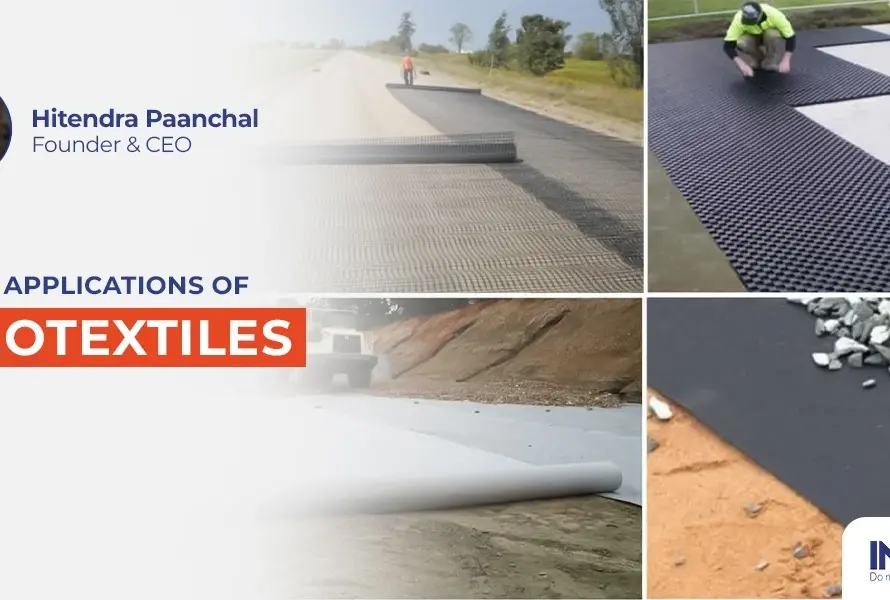
A geogrid locks into granular fill and stiffens it, turning a marginal layer into a working platform over soft ground. For the heavy jobs, our INDODRAIN PET Geogrid carries the high-load reinforcement.
On very soft ground, a geocell goes further. Indokon Geocell confines the infill in its honeycomb so nothing spreads sideways, forming a stiff mattress over weak soil. Underneath it all, a separation geotextile keeps the soft subgrade from pumping up into the fill.
Product | Role in Ground Improvement | Suits |
|---|---|---|
PET Geogrid | High-strength reinforcement | Embankments, tall loads |
PP Geogrid | Base and subgrade stabilization | Roads, platforms |
Geocell | Cellular confinement mattress | Very soft or wet soil |
Geotextile | Separation and filtration | Under fill, drain wraps |
Chemical and Column Methods
Chemical methods bind soil grains with a stabilizing agent, while column methods insert stiff inclusions like stone columns, aggregate piers, and rigid inclusions to carry the load. Both change the ground from the inside.
These are the heavier interventions, used when densifying or reinforcing alone won’t reach deep enough.
Stabilizing Agents and Stone Columns
Lime or cement mixed into clay dries it out and stiffens it, and grouting injects a binder to fill voids and lock the grains. Deep soil mixing does the same job in columns, well below the surface.
Stone columns take a different route. Crushed stone is rammed into the soft clay in vertical columns that both reinforce and drain, and a geotextile sleeve is often wrapped around each one so the clay can’t contaminate the stone. India covers these under IS 15284 Part 1.
Two close cousins round out the family. Aggregate piers ram stone in thin, compacted lifts for a stiffer column, while rigid inclusions are slender concrete elements that carry load straight through very soft layers to firmer ground below.
Types of Ground Improvement in Indian Practice
The types of ground improvement used on Indian sites are governed by IS 13094 for selection and IS 15284 for the main deep methods. The codes take a lot of the guesswork out.
Indian soils swing from Gujarat’s black cotton clay to coastal marine deposits, and the standards are written around exactly those problem grounds.
The IS Codes That Govern Selection
IS 13094 is the selection guide. It screens techniques against soil type, target bearing capacity, settlement tolerance, and groundwater, so you shortlist before you spend.
IS 15284 then carries the deep methods, Part 1 for stone columns and Part 2 for preconsolidation with vertical drains. For the geosynthetic reinforcement side, IRC:SP:59 and IS 17373 cover the geogrid and geotextile detail.
Method | Governing Indian Code |
|---|---|
Selecting a technique | IS 13094 |
Stone columns | IS 15284 Part 1 |
Vertical drains, preloading | IS 15284 Part 2 |
Geosynthetic reinforcement | IRC:SP:59, IS 17373 |
Soil Improvement Techniques: How to Choose
The best of the soil improvement techniques for a site is the one that matches the soil, the load, and the depth of the problem, not the fanciest option. Start with the soil report, not the catalog.
Choosing well saves more than money. Over-treat a site and you burn budget; under-treat it and you’re back fixing settlement in a year.
The Selection Checklist
Run four questions. What’s the soil, how deep is the weak layer, how much load is coming, and how fast do you need it ready?
Shallow and granular points to compaction or geosynthetics. Deep and soft clay points to drains or stone columns. Where load spreads over soft ground, reinforcement often beats the deep options on cost, and a lighter INDODRAIN PP Geogrid platform is a common, economical way to do it.
Factor | Why It Decides the Method |
|---|---|
Soil type | Sand densifies, clay drains or reinforces |
Depth of weak layer | Shallow suits surface methods |
Design load | Heavy loads push toward columns |
Time available | Drains and geosynthetics are faster |
Budget | Reinforcement often beats deep piles |
Ground Improvement in Geotechnical Engineering
Ground improvement in geotechnical engineering earns its place because it’s usually cheaper and faster than deep foundations or digging the bad soil out. That’s why it has become standard on soft sites.
A generation ago, a weak site meant piles or excavation. Now the ground itself gets treated, and the structure sits on improved soil.
Cost, Speed, and Sustainability
The savings are real. Improving the ground can cost a fraction of a piled raft, a point we walk through in our note on the bearing capacity of soil, and it skips the spoil and haulage that soil replacement drags along.
There’s a green angle too. Reinforcing with geosynthetics cuts the imported aggregate and cement a site would otherwise swallow, which trims both cost and carbon.
That combination, lower cost and lower footprint, is why more Indian tenders now specify ground improvement over piling wherever the soil allows it.
Approach | Relative Cost | Speed | Spoil Generated |
|---|---|---|---|
Deep piling | High | Slow | Moderate |
Soil replacement | High | Slow | Heavy |
Ground improvement | Lower | Faster | Little |
Start With the Soil Report
Ground improvement goes wrong when the method is chosen before the soil is understood. The soil report should decide the family, every time.
Loose ground wants densifying. Wet clay wants draining. Soft, load-bearing ground wants reinforcement, and that’s where our geosynthetics do their work.
Match the method to what the report actually shows, cite the right IS code, and you’ll spend once instead of twice. When you’re weighing the options, the team at Indonet Group can size the reinforcement to your soil and your loads.
Frequently Asked Questions
What are ground improvement techniques?
Ground improvement techniques are methods that strengthen weak or soft soil so it can support a structure without deep foundations. They fall into four families: mechanical densification, hydraulic drainage, reinforcement with geosynthetics or columns, and chemical binding.
Which ground improvement method is best for soft clay?
Soft clay usually calls for hydraulic methods or reinforcement. Preloading with vertical drains speeds its consolidation, while geosynthetics and stone columns reinforce and spread the load. Densification doesn’t work on clay because it’s too fine and wet.
How do geosynthetics improve weak ground?
Geosynthetics add the tensile strength soil lacks. A geogrid stiffens granular fill into a working platform, a geocell confines soft ground in a honeycomb mattress, and a geotextile separates and drains, all of which raise bearing capacity and cut settlement.
What is the difference between ground improvement and soil stabilization?
Ground improvement is the broad category of strengthening weak ground, covering mechanical, hydraulic, reinforcement, and chemical methods. Soil stabilization is one branch of it, usually the mechanical and chemical treatment of soil to improve strength.
Which Indian codes cover ground improvement?
IS 13094 guides the selection of a technique, IS 15284 Part 1 covers stone columns, and IS 15284 Part 2 covers preconsolidation with vertical drains. Geosynthetic reinforcement follows IRC:SP:59 and IS 17373.
Is ground improvement cheaper than deep foundations?
Often, yes. Improving the ground can cost a fraction of a piled foundation and is usually faster, with far less spoil to haul away. The saving is biggest where a load spreads over soft soil rather than concentrating on a few points.

Hitendra Panchal
Founder & CEOMr. Panchal is on a mission to revolutionize India's plastics landscape. Under his leadership, Indonet delivers essential solutions that fortify infrastructure, construction, and agriculture projects. Since 2007, he has built a manufacturing powerhouse specializing in high-performance geosynthetics and extruded netting.A champion of the "Make in India" initiative, he drives sustainable innovation to build resilient supply chains. Mr. Panchal empowers businesses to enhance project integrity and long-term value through world-class, engineered plastic solutions trusted globally.