|
Getting your Trinity Audio player ready... |
Table of Contents
- 1 Road Construction Layers: The Full Stack in One Look
- 2 The Road Cross Section, Bottom to Top
- 3 Subgrade in Road Construction: The Foundation
- 4 Granular Sub Base: The Working Platform
- 5 Base and Binder Courses: Carrying the Load
- 6 The Surface Course: Where Rubber Meets Road
- 7 Layers of Road Pavement: How the IRC Codes Tie It Together
- 8 How Geosynthetics Strengthen Every Layer
- 9 The Bottom Line on Road Construction Layers
- 10 Frequently Asked Questions
- 10.1 What are the layers of a road from bottom to top?
- 10.2 What is the subgrade in road construction?
- 10.3 What does the granular sub base do?
- 10.4 What is the difference between the base and sub base?
- 10.5 Which code governs pavement design in India?
- 10.6 How do geosynthetics help road construction layers?
Road construction layers run from the subgrade at the bottom to the surface course on top, with the granular sub base, base, and binder stacked between them. Each layer takes the traffic load and hands a gentler share to the one below. When a road fails, the top is rarely to blame. The real trouble usually sits lower, in the subgrade or the drainage, and that is where geosynthetics like geotextiles, geogrids, and geonets do the quiet work of holding a road together.
We make the geotextiles, geogrids, geocells, and geonets that go into road construction layers, so we tend to see a road from the inside out. A road is never one solid slab.
It’s a stack. Each layer carries the traffic load and hands a gentler version of it to the layer below.
Get that chain right and the road runs for decades. Miss a link and it shows up top as rutting and cracks, long after the real trouble started somewhere below. Here is the full stack, bottom to top, and where the materials we make quietly do their work.
Road Construction Layers: The Full Stack in One Look
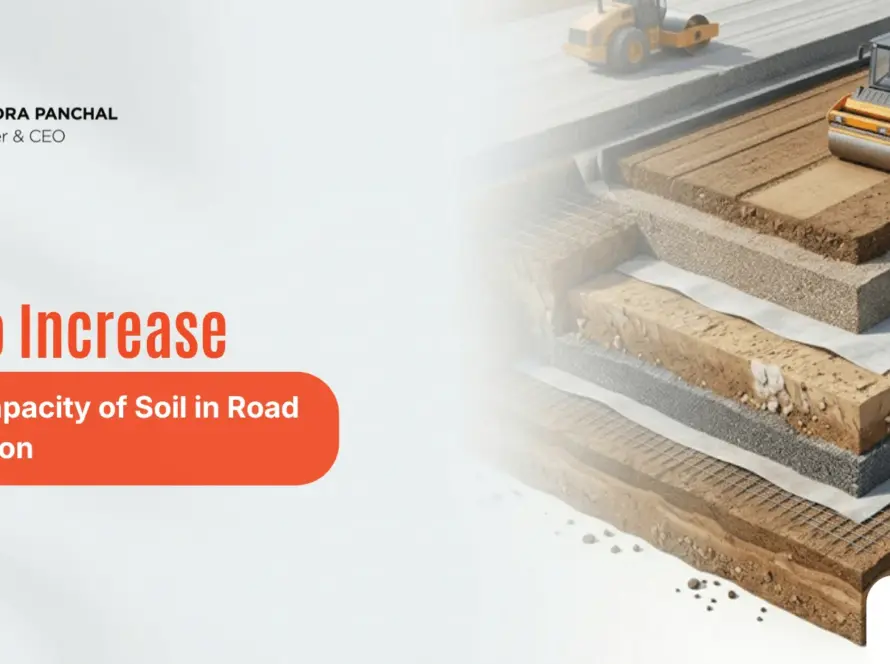
A flexible road is built in five layers: subgrade, granular sub base, base, binder, and surface course. Each one is stronger than the layer beneath it.
The load starts as a sharp point under a wheel and spreads wider as it travels down. By the time it reaches the soft subgrade, it’s gentle enough not to do harm.
Why Roads Are Built in Layers
You could never lay bitumen straight onto soil and expect it to hold. The soil would pump, sink, and tear the surface apart in a season.
So each layer does one job and protects the next. Strong material up top where the load is sharp, cheaper granular material below where it has spread out.
Layer | Role | Typical Material | Typical Thickness |
|---|---|---|---|
Surface course | Smooth, waterproof riding layer | Bituminous concrete | 40 to 50 mm |
Binder course | Carries and spreads the load | Dense bituminous macadam | 50 to 100 mm |
Base course | Main structural layer | Wet mix macadam | 150 to 250 mm |
Granular sub base | Drainage and load spread | Graded aggregate | 150 to 300 mm |
Subgrade | Prepared foundation soil | Compacted natural soil | Full formation |
The Road Cross Section, Bottom to Top
A road cross section shows the layers stacked in order, each thinner and stronger toward the top. Read it from the bottom and the logic is obvious.
The subgrade holds everything. Above it, granular layers spread the load, and the bituminous layers on top take the traffic and keep water out.
Reading a Flexible Pavement Cross Section
The flexible pavement layers work as a team, not as separate slabs. Flex one and the others flex with it, which is exactly why the soft layers below must be protected.
That protection is where separation and drainage matter most. A clean cross section stays clean only if the subgrade fines never migrate up and the water always has a way out.
Most road failures trace back to a specific layer, and reading them backward tells you what went wrong below.
Layer That Fails | What You See | Usual Cause |
|---|---|---|
Surface course | Cracks, potholes | Water ingress, thin mix |
Base course | Rutting | Weak or thin base |
Granular sub base | Rutting, pumping | Clogged, poor drainage |
Subgrade | Deep settlement | Low CBR, no separation |
Subgrade in Road Construction: The Foundation
The subgrade in road construction is the prepared soil that carries the entire pavement, and its strength is measured by CBR. Weak subgrade, weak road.
Everything above is designed around this one number. A firm subgrade needs less material above it; a soft one needs a lot more, or some help.
Why a Weak Subgrade Sinks the Whole Road
In India, design follows IRC:37, which sets the pavement thickness from the subgrade CBR and the traffic. A CBR above 5 percent is workable.
Below 5 percent the code asks you to improve the soil, and below 2 percent it almost always needs treatment. Black cotton soil and other soft ground across the country fall right into this trap.
Where Geosynthetics Come In
This is where the materials we make earn their place. A separation geotextile keeps the soft subgrade and the granular layer from mixing, so the sub base stays clean and strong.
On weaker ground, a geogrid confines the aggregate and lifts the effective strength of the layer, and on the softest or most expansive soils, a geocell holds the fill in place so nothing spreads. Our INDODRAIN Geotextile handles separation, the INDODRAIN PET Geogrid handles reinforcement, and Indokon Geocell handles confinement.
Subgrade CBR | What It Means | Sensible Action |
|---|---|---|
Above 8 percent | Firm foundation | Standard design |
5 to 8 percent | Workable | Standard design, watch drainage |
2 to 5 percent | Weak | Improve soil or add geosynthetics |
Below 2 percent | Very poor | Treat, replace, or reinforce |
Granular Sub Base: The Working Platform
The granular sub base sits on the subgrade and does three jobs: spread the load, drain water, and give a platform to build on. It is the quiet workhorse of the stack.
Made from well-graded aggregate, the granular sub base carries traffic stress down to a safe level before it reaches the soil. It also keeps water moving sideways and out, away from the subgrade.
What the GSB Actually Does
MoRTH specifies the granular sub base grading, and IRC:37 splits it into a drainage layer on top and a filter or separation layer below. Together they stop water from pooling and stop fines from clogging the road from beneath.
A clogged or under-compacted sub base is a classic cause of early rutting. Water gets trapped, the subgrade softens, and the load spread collapses.
Keeping Water and Fines Out
A separation geotextile at the bottom of the granular sub base does the filter job that the code asks for. It lets water pass while holding the subgrade fines back, which keeps the layer draining for years.
For sites that need active drainage, a geonet moves water within its own plane and carries it out to the edge. Our INDODRAIN Geonets do exactly that inside and below the sub base.
GSB Function | How It Helps | How It’s Specified |
|---|---|---|
Load spreading | Reduces subgrade stress | Thickness per IRC:37 |
Drainage | Removes water sideways | MoRTH drainage grade |
Filtration | Blocks subgrade fines | MoRTH filter grade |
Working platform | Supports base construction | Compaction to spec |
Base and Binder Courses: Carrying the Load
The base course carries the heaviest structural load, and the binder course above it ties the base to the surface. These are the muscle of the pavement.
The base takes the sharpest stress that gets past the surface and spreads it onto the sub base. Build it weak and no surface, however good, will save the road.
Wet Mix Macadam and the Bituminous Layers
The base is usually wet mix macadam, a dense, crushed, well-graded aggregate laid and rolled to a tight finish. Above it sits dense bituminous macadam, the binder that bonds the structure to the wearing course.
Both are specified under MoRTH, with grades tied to the traffic the road will carry. Heavier traffic means thicker, stiffer layers.
Reinforcing the Base With Geogrid
A geogrid laid in or under the base does something worth the money. It locks the aggregate in place, cuts the rutting, and can let you shave thickness or extend the life of the layer.
On soft ground, that reinforcement is often the difference between a road that holds and one that ruts every monsoon. The PET geogrid that reinforces a subgrade earns its keep in the base for the same reason.
The Surface Course: Where Rubber Meets Road
The surface course is the thin, tough top layer that carries traffic directly and keeps water out of everything below. It gets all the attention and does less structural work than people think.
Its real jobs are grip, smoothness, and waterproofing. If it lets water through to the layers below, the whole stack starts to fail from the top down.
Bituminous Concrete and the Wearing Course
The wearing course is usually bituminous concrete, a fine, dense mix built for skid resistance and a smooth ride. It’s thin, often just 40 to 50 mm, because it doesn’t carry the structural load.
In India the bitumen grade shifts with the climate zone, since a mix that holds in a hill state would bleed in a desert summer. That choice sits in IRC:37 too.
Layers of Road Pavement: How the IRC Codes Tie It Together
The layers of road pavement in India are governed by IRC:37 for design and MoRTH for materials, with pavement design driven by subgrade CBR and traffic. Cite the right code and the spec falls into place.
Pavement design isn’t guesswork. The thickness of every layer traces back to two inputs, how weak the soil is and how heavy the traffic will be.
IRC:37, MoRTH, and Where the Numbers Come From
IRC:37 turns subgrade CBR and design traffic into a layer stack, with the IITPAVE tool handling the heavier calculations. MoRTH then fixes the material grading and quality for each layer.
For drainage and separation, IRC:37 points to geosynthetic filter and drainage layers, which is where our geotextiles, geonets, and geogrids fit the design directly. Rigid concrete pavements follow a different path under IRC:58, a topic for another day.
Layer | Governing Reference | Typical Spec |
|---|---|---|
Subgrade | IRC:37 | Design CBR, compaction |
Granular sub base | IRC:37, MoRTH | CBR 20 to 30 percent |
Base course | MoRTH | Wet mix macadam grade |
Bituminous layers | IRC:37, MoRTH | Grade by traffic and climate |
Geosynthetic layers | IRC:37, IRC:SP:59 | Separation, drainage, reinforcement |
How Geosynthetics Strengthen Every Layer
Geosynthetics work at the weak points of the stack: separation and reinforcement at the bottom, drainage through the sub base. One product rarely does it all.
The trick is matching the material to the problem in that layer. Get that right and a marginal road becomes a durable one without gold-plating every layer.
Matching the Product to the Layer
Separation belongs at the subgrade line, reinforcement in the weak lower layers, drainage through the sub base. Each has a product built for the job, and layering two is common on soft sites.
If you want the wider view of these materials in roads, we cover it in our note on geosynthetics used in road construction.
Layer | Common Problem | Product | What It Does |
|---|---|---|---|
Subgrade | Fines pump into sub base | INDODRAIN Geotextile | Separates soil and aggregate |
Weak subgrade | Low bearing strength | INDODRAIN PET Geogrid | Reinforces and stiffens |
Very soft soil | Fill spreads and sinks | Indokon Geocell | Confines the fill |
Sub base | Trapped water | INDODRAIN Geonets | Drains water sideways |
The Bottom Line on Road Construction Layers
After years of making the materials that go into these layers, we’ve learned the road almost never fails at the top. It fails from the bottom, at the subgrade or the drainage nobody watched closely enough.
So read the stack from the ground up. Build a firm subgrade, keep the granular sub base clean and draining, then let the base and surface do their jobs.
Where the soil is soft or the water won’t leave, the right geosynthetic in the right layer is cheaper than the rebuild that follows a failure. Want a second look at a layer design? The team at Indonet Group sizes separation, reinforcement, and drainage into Indian road layers every week.
Frequently Asked Questions
What are the layers of a road from bottom to top?
From the bottom up, the road construction layers are the subgrade, granular sub base, base course, binder course, and surface course. Each layer is stronger than the one below and spreads the traffic load onto it.
What is the subgrade in road construction?
The subgrade is the prepared natural soil that forms the road’s foundation. Its strength, measured as CBR, decides how much material the pavement needs above it, so a weak subgrade means a thicker or reinforced design.
What does the granular sub base do?
The granular sub base spreads the load onto the subgrade, drains water sideways out of the pavement, and gives a stable platform to build the base on. It is graded and compacted to MoRTH specifications.
What is the difference between the base and sub base?
The base course is the stronger structural layer directly under the surface, usually wet mix macadam. The granular sub base sits below it on the subgrade and handles load spreading, drainage, and filtration.
Which code governs pavement design in India?
Flexible pavement design follows IRC:37, with material specifications from MoRTH, while rigid concrete pavements follow IRC:58. Layer thickness is set from the subgrade CBR and the design traffic in million standard axles.
How do geosynthetics help road construction layers?
Geosynthetics separate the subgrade from the sub base, reinforce weak layers to carry more load, and drain water out of the pavement. That means less rutting, a longer life, and often a thinner design over soft ground.

Hitendra Panchal
Founder & CEOMr. Panchal is on a mission to revolutionize India's plastics landscape. Under his leadership, Indonet delivers essential solutions that fortify infrastructure, construction, and agriculture projects. Since 2007, he has built a manufacturing powerhouse specializing in high-performance geosynthetics and extruded netting.A champion of the "Make in India" initiative, he drives sustainable innovation to build resilient supply chains. Mr. Panchal empowers businesses to enhance project integrity and long-term value through world-class, engineered plastic solutions trusted globally.