|
Getting your Trinity Audio player ready... |
Table of Contents
We all have a local road that develops cracks and potholes every monsoon. No matter how many times it gets reconstructed, it lasts even a full year!
Ever wondered why something like this happens?
You may think it’s just the traffic above ruining its structure. But actually, it’s the water below the road that is trapped and slowly degrading its strength.
When rainwater seeps into the pavement beneath, it has no other place to go. Thus, it gets trapped and softens the soil beneath the road.
The solution? Use subsurface drainage during your road construction.
Using subsurface drainage, you can easily capture groundwater and drain it. This results in a lack of water pressure building up beneath your roads.
With no water pressure, the roads stay dry and remain reliably secure year-round.
Excited to use this technique in your next construction?
Let’s start by understanding why this road drainage system is so important.

Why Subsurface Drainage Matters?
Water can be surprisingly destructive, especially for structures. If trapped, it can lead to soil degradation that can collapse even newly-built roads.
To avoid these issues, moisture needs to be drained out beneath the roads. This is the only reliable way to ensure the soil’s bearing capacity remains intact.
A well-designed road drainage system can help prevent road degradation. Such systems are made to catch water before it can cause any damage and safely remove it.
Key Components of a Subsurface Drainage System
Most modern highway water management systems include one of these solutions:
Traditional Drains (Pipes and Trenches)
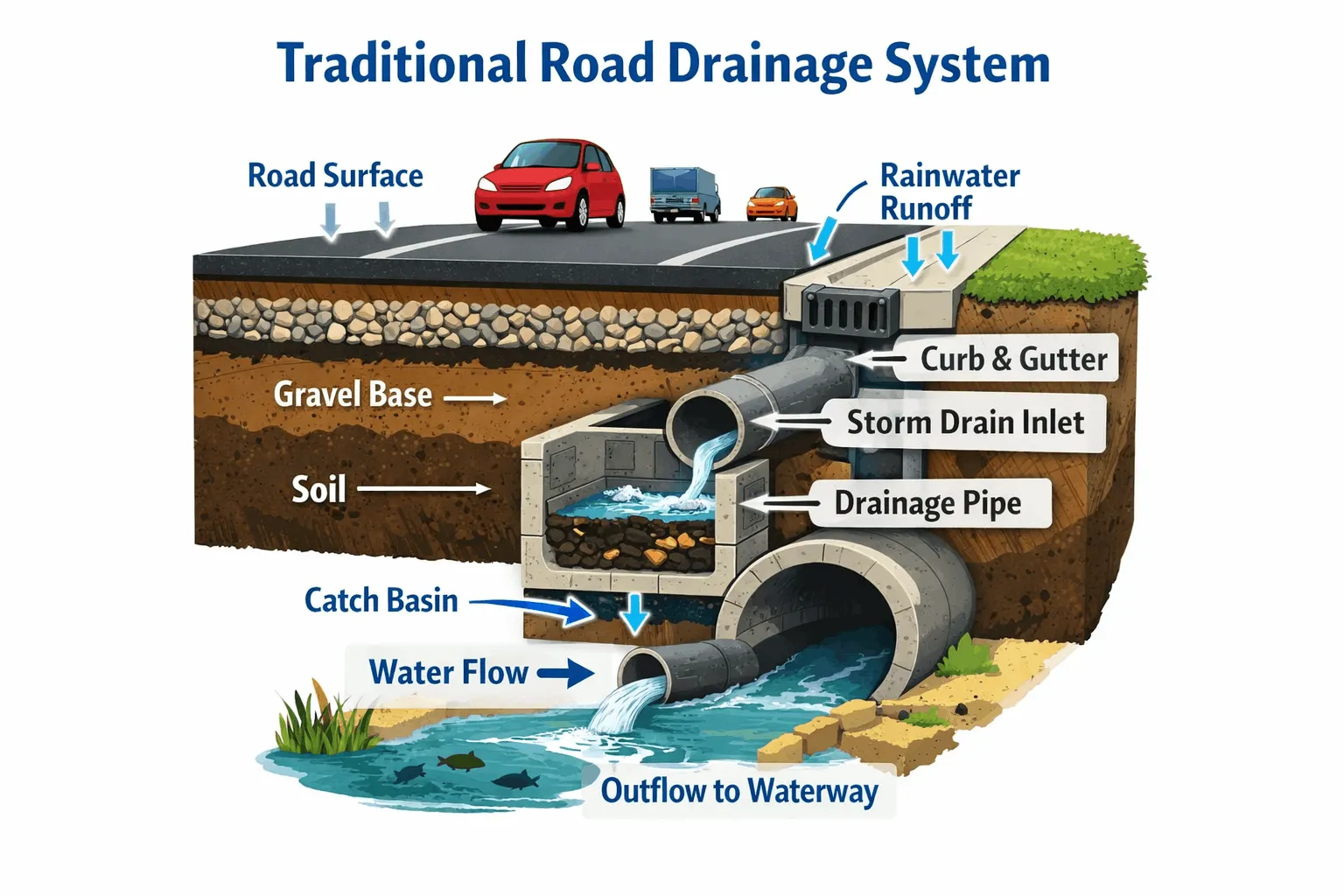
The old approach towards subsurface drainage involved digging a trench alongside the road. This trench helped collect water and safely carry it away from the road.
Using gravel and pipes, the water in these trenches was redirected. Usually, the water was diverted towards ditches and ponds to safeguard the roads.
While this is an effective solution, constructing such gravel drains can be expensive. It also takes up a lot of space alongside the road.
Modern Solutions (Geonets and Geocomposites)
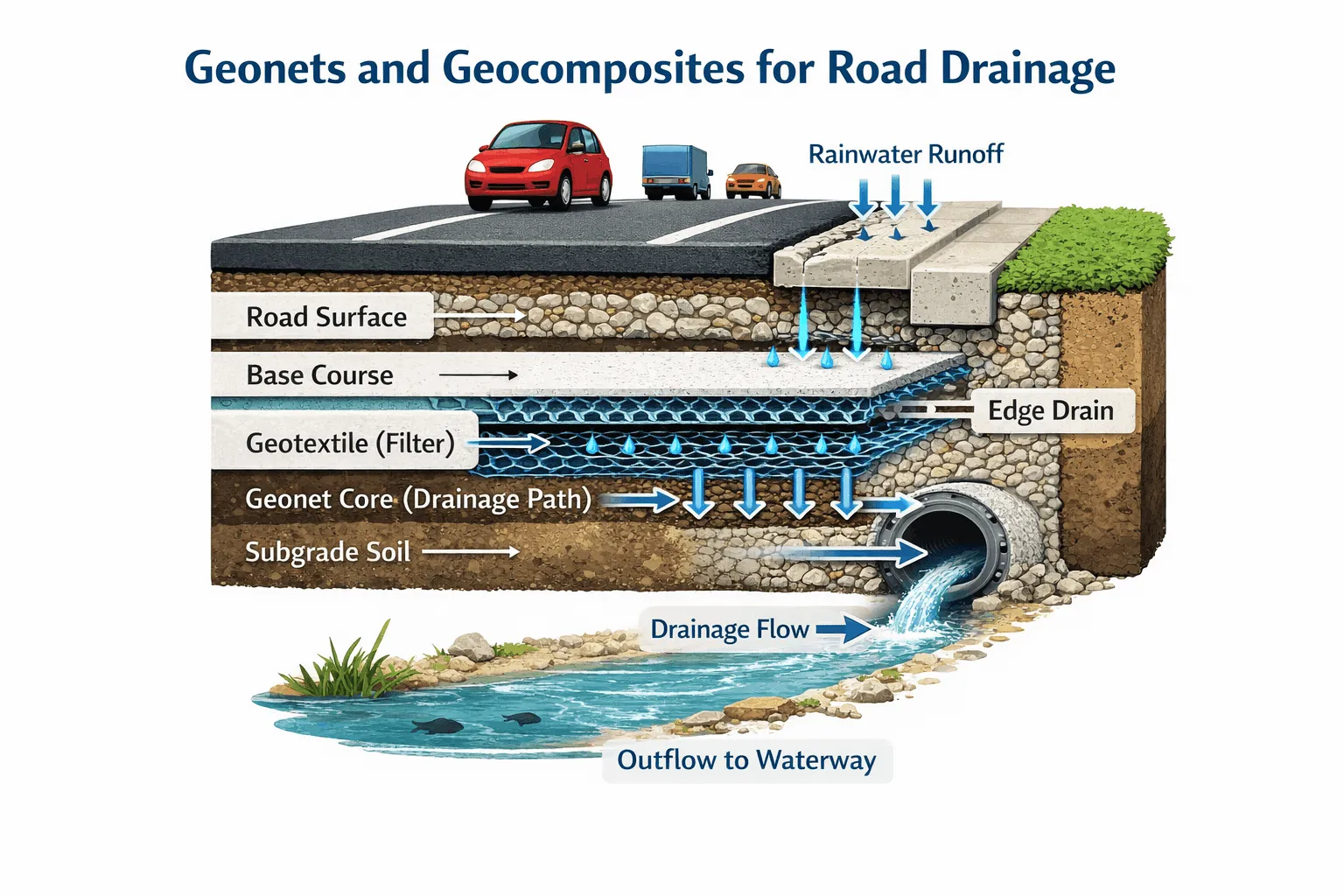
As traditional drains had some glaring issues, modern alternatives need to be innovated.
That is exactly what geonets and geocomposites achieved in the modern age. Using synthetic materials, they removed the need for thick gravel layers to drain water away from roads.
Moreover, these geonets are much thinner and a lot more effective. This is particularly true for geonets, which are rapidly becoming the default alternative to traditional drains.
In geonets, a plastic mesh is constructed with a three-dimensional structure. It adds a drainage layer in the pavement that allows water to flow freely.
Geocomposites are formed by bonding two or more geotextile fabrics together. This creates a more complex solution that can even remove soil particles from the water.
Such combinations make geosynthetic drainage systems the best solution for subsurface drainage today.
Geonets vs Geocomposites: What Are the Differences?
Let’s look into a short comparison between these two synthetic solutions:
Feature | Geonet | Geocomposite |
Structure | Open, net-like plastic core | Geonet core + Geotextile layer(s) |
Primary Function | Convey water within its plane | Drainage + Filtration/Separation |
How It Works | Creates channels for water flow | Geonet drains; Geotextile filters soil |
Best For | Simple drainage layers | Sites with fine soils that could cause clogging |
Installation | Placed as a single layer | Rolls out quickly; replaces gravel and filter layers |
Where are Such Drains Placed?
Drains are not magical solutions that can automatically remove water from roads. Choosing the right placement for these subsurface drainage systems is very important.
Here are ways how engineers usually combat this issue:
Longitudinal Drains
These are drains that typically run alongside the edge of roads and pavements.
They catch the water that seeps out from under the road.
Transverse Drains
These refer to drains that run across the road and intercept water.
Usually, such drains are used on slopes, where intercepting drains can be placed downhill.
Cut-off Drains
Such drains are placed over cuts to prevent groundwater from flowing down to the road.
For example, a drain can be placed on top of a hill that is beside a road to prevent water from flowing down.
Conclusion
Building a road requires a lot more than just asphalt and maps. It requires durable materials and strategies to make them sustainable.
As water threatens road integrity, strong subsurface drainage has become a necessity.
Given that modern geosynthetics have clearly outperformed traditional methods, they are the ideal choice. Such synthetic materials can prolong the road’s lifespan at minimal cost and with minimal maintenance.
But where can you find reliable geonet manufacturers that can offer modern solutions at the right price? And what about installing and maintaining them?
Thankfully, I have a great recommendation! For high-performance drainage materials, look no further than Indonet!
Indonet is a trusted supplier and manufacturer of advanced plastic geocomposites. They are known in the industry for their innovative geonets and drainage systems.
Moreover, Indonet has a legacy of bringing quality and durability to its products. Their commitment towards thoughtful engineering continues to make their products more sustainable.
Whether you are designing highway water management or a drainage layer in pavements, you really can’t go wrong with Indonet!
So what are you waiting for? Contact the experts at Indonet today and receive a free consultation!
FAQs
- What is subsurface drainage in roads?
Subsurface drainage is a hidden system that removes water from beneath the road. It prevents groundwater from weakening the soil and pavement layers, extending the life of the road. - How do geonets work for drainage?
Geonets are plastic mesh-like materials with built-in channels. They create a thin, effective drainage layer in pavement that allows water to flow quickly to collection pipes. - What’s the difference between geonets and geocomposites?
A geonet is the drainage core. A geocomposite combines the core with a geotextile fabric filter that prevents soil from clogging the system while allowing water to pass through. - Why is highway water management important?
Proper highway water management prevents water buildup that causes rutting, cracking, and potholes. It keeps the road structure dry and safe for heavy traffic. - What is a geosynthetic drainage system?
A geosynthetic drainage system uses synthetic materials, such as geonets and geocomposites, to replace traditional gravel drains. It saves space, installs faster, and provides reliable long-term performance.