|
Getting your Trinity Audio player ready... |
Table of Contents
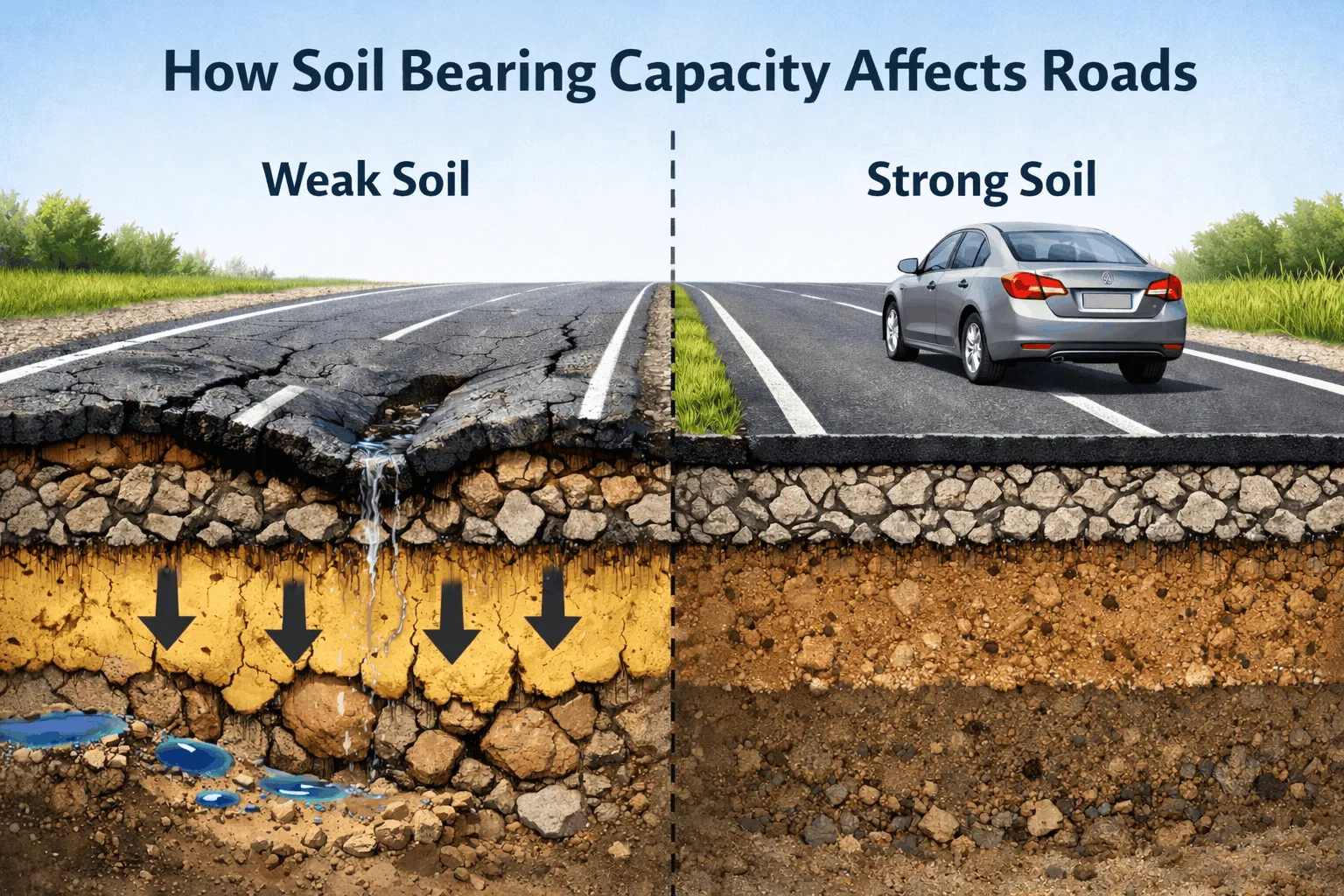
Have you ever noticed the wavy dips or cracks on roads? It’s a very common issue, especially in India.
Curious about how it happens? It’s mainly due to the ground beneath the road failing to handle the heavy loads of the vehicles.
For any road to last durably, it requires a strong foundation. For roads, this foundation comes from the soil hidden beneath.
The bearing capacity of soil is thus one of the most important factors that determines the strength of a road. It determines whether the road can withstand the regular stress of heavy trucks and cars above.
Thankfully, there is a way to ensure this strength is maintained consistently over the years. It is through modern engineering and ground improvement techniques.
Let’s explore the different ways you can use these methods to increase the bearing capacity of soil.
Main Problems Caused by the Bearing Capacity of Soil In Roads
Before trying to increase the bearing capacity of soil, you must first understand the main issue.
Not all soils are weakened for the same reason. Some are prone to squeezing, while others, like loose sand, can shift or vibrate. There are even soils, such as “black cotton soil,” that can expand by absorbing rainwater.
Engineers use tests to determine the bearing capacity of soil. A common way to determine this factor is by using the California Bearing Ratio (CBR) test.
In this test, a plunger is driven into the soil to measure the resistance encountered during penetration. Depending on the road’s CBR, its bearing capacity can be assessed.
A CBR below 3% can indicate that the road needs significant improvement in soil bearing capacity.
Common Ground Improvement Methods
To make your road construction projects more sustainable, it is important to use the right techniques. These generally include using the following methods:
Mechanical Stabilization
One of the most traditional ground improvement methods is compaction. This uses heavy rollers to squeeze soil particles together.
This way, you can increase the density of your soil and make it much harder. Such stabilization is typically used in every weak-soil treatment strategy.
Chemical Stabilization
For soil types like clays, mixing chemicals directly into the ground can dramatically change its properties. Some examples include:
Lime or Cement
Adding lime to any heavy clay soil triggers a chemical reaction. It helps in reducing the soil’s plasticity and its ability to swell or shrink.
The reaction helps bind soil particles together, creating a more durable layer. Cement works similarly to increase soil strength.
Bitumen Stabilization
To increase the bearing capacity of soil, bitumen can be added. It has the unique ability to bind soil particles together.
This method is also used to increase soil water resistance.
Geosynthetic Reinforcement
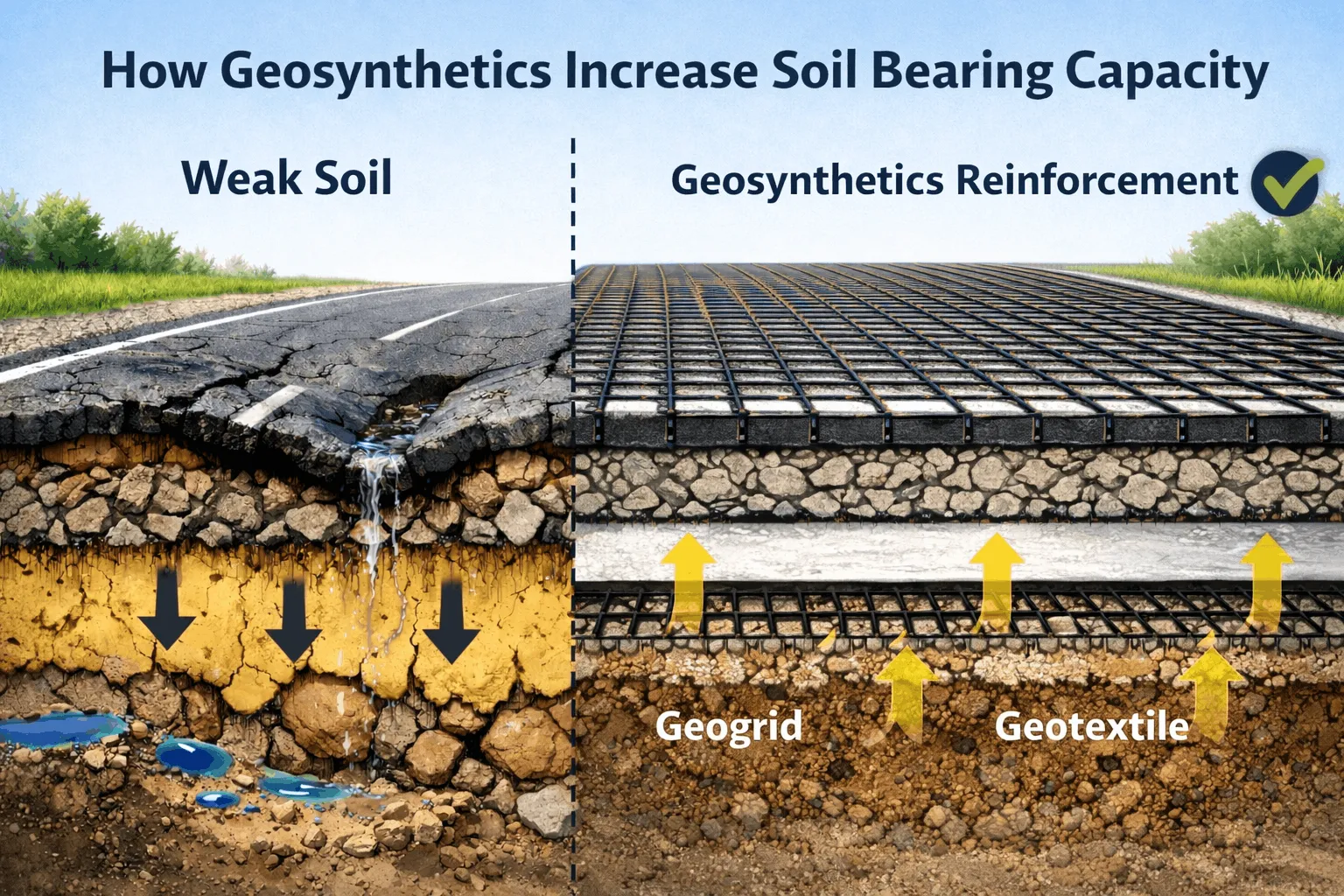
While traditional methods may still be effective, they are far more costly and less effective than modern alternatives. One of the best examples of this superior modern product is the usage of geosynthetics in road construction.
Using a geogrid or geocell can provide far superior strength during road construction. Let’s understand each of these technologies in more detail:
Geogrid
Geogrids are shaped like mesh, with plastic grids and large openings. They are usually placed on the ground to improve soil stabilization.
These cells combine to form a durable layer that provides greater strength and reliability to the road. It holds the soil together and helps spread the vehicle load over a wider area.
Geocell
If geogrids are a 2D reinforcement solution, Geocells are a 3D alternative. These are honeycomb-like mats that form a series of interconnected cells.
These cells are hollow and are usually filled with sand or gravel. The walls of the geocell confine this material, preventing it from moving side-to-side.
In practice, such geocells go a long way towards increasing soil bearing capacity.
Geocell vs. Geogrid: A Quick Comparison
Here is how geocells and geogrids compare against each other for road subgrade stabilization:
Feature | Geogrid | Geocell |
Structure | 2D open-grid mesh | 3D honeycomb pockets |
How It Works | Locks aggregate in place | Confines infill laterally |
Best For | Base reinforcement | Very soft ground |
Key Benefit | Load distribution | Superior confinement |
Material | Polymeric mesh | HDPE strips |
Installation | Roll placement | Expand and fill |
Typical Height | Thin (a few mm) | 50mm to 200mm+ |
Slope Use | Retaining walls | Erosion control |
Load Support | Moderate | High |
Soil Confinement | Planar only | Full 3D |

Conclusion
So, how can you choose the right method for increasing the load-bearing capacity of soil?
The answer lies heavily on your soil type and budget. For minor issues, even traditional methods can provide the load-bearing you require.
But for most modern road construction, ground improvement techniques such as geogrids and geocells have become necessary. They empower much higher durability and capacity at a fraction of the cost of other techniques.
That being said, your quality of work will depend entirely on the supplier you choose for your geosynthetics. To make it as efficient as possible, I recommend choosing Indonet as your preferred partner.
Why? Indonet has already established itself as a market leader in both manufacturing and supplying geosynthetic solutions. Their main expertise as geocell and geogrid suppliers makes them excellent for road construction solutions.
Moreover, their commitment to reliability and efficiency is truly commendable. Not only are their manufacturing processes sustainable, but they also assure expert after-sales support.
Whether it’s for making a highway or a rural access road, their customizable solutions are always at your disposal. With their engineering excellence, your next road construction project is sure to stand the test of time.
Contact the experts at Indonet today and discuss your next project to receive proper guidance and expert solutions.
FAQs
1. What is the bearing capacity of soil?
Bearing capacity of soil is the ground’s ability to support loads from structures like roads without failing or excessive settlement.
2. How does a geocell improve weak soil?
Geocell confines infill material in 3D pockets, preventing lateral movement and increasing stiffness for better load distribution.
3. What are common ground improvement techniques?
Key ground improvement techniques include compaction, chemical stabilization with lime or cement, and reinforcement using geogrid or geocell.
4. When is weak soil treatment necessary?
Weak soil treatment is needed when soil has low CBR values, high clay content, or fails to support construction equipment without rutting.
5. What is road subgrade stabilization?
Road subgrade stabilization strengthens the native soil layer using mechanical, chemical, or geosynthetic methods to create a durable foundation.