|
Getting your Trinity Audio player ready... |
Table of Contents
- 1 What a Geomembrane Is, and Why It’s Never Alone
- 2 Types of Geomembrane: HDPE, LLDPE, PVC, and More
- 3 HDPE Liner: The Workhorse for Big Containment
- 4 Geomembrane Sheet Thickness and Technical Specifications
- 5 Pond Liner Uses: Aquaculture, Irrigation, and Storage
- 6 Canal Lining and Water Conservation
- 7 Landfill Liner Systems and the Drainage Behind Them
- 8 Common Problems and Engineering Solutions
- 9 Geomembrane and Pond Liner in Indian Practice
- 10 How to Choose the Right Geomembrane: A Procurement Checklist
- 11 Plan the System, Not Just the Sheet
- 12 Frequently Asked Questions
- 12.1 What is a geomembrane?
- 12.2 What is the difference between a geomembrane and a pond liner?
- 12.3 Which geomembrane is best for a pond?
- 12.4 What thickness of geomembrane do I need?
- 12.5 Which Indian standard covers geomembranes?
- 12.6 Does a geomembrane need a drainage or protection layer?
- 12.7 How long does a geomembrane liner last?
A geomembrane is the near-impermeable sheet that lines ponds, canals, reservoirs, and landfills. HDPE for the big or aggressive sites. LLDPE where the ground moves. PVC for the small stuff. Set the thickness from the liquid, the exposure, and the life you need, usually 0.5 to 3.0 mm, and never skip the protection and drainage layers. In India the spec to quote is IS 16352; GRI-GM13 and GRI-GM17 are the global ones.
For engineers, aquaculture operators, and procurement teams, the geomembrane is the part of a project that decides whether water stays where it should. Get the specification right and a pond or canal holds for decades. Get it wrong and the liner cracks, leaks, or leaches, and the repair costs more than the original job.
This guide covers the geomembrane types, the specifications that matter, where each material fits, the failures that turn up in the field, and how to specify and procure a liner. As a geosynthetics manufacturer, we supply the geotextile protection and drainage layers that pair with a liner, so the perspective here is the full containment system, not the sheet alone.
What a Geomembrane Is, and Why It’s Never Alone
A geomembrane is the barrier layer in a lined system, an impermeable polymer sheet in HDPE, LLDPE, or PVC. For HDPE, permeability sits near 1×10⁻¹⁴ m per second. That’s watertight in any practical sense.
The sheet has three jobs. Block the flow, resist the chemicals it holds, and take the stress from water pressure and ground movement. It does none of that on its own, though.
The Barrier and Its Support Layers
A real system is layered. A protection geotextile cushions the liner from the subgrade, the geomembrane seals, and a drainage layer relieves water, gas, or leachate behind it.
Skip the cushion and one 20 mm stone punctures it in the first season. Skip the drainage and trapped pressure lifts the sheet and tears it.
Both failures are avoidable. Our geosynthetics range covers the geotextiles and drainage composites that keep a liner alive.
Types of Geomembrane: HDPE, LLDPE, PVC, and More
Four materials cover the field: HDPE, LLDPE, PVC, and EPDM. They rank by chemical resistance, flexibility, and how long they last. It’s the first call you make, and it drives everything after.
HDPE leads on chemical resistance and durability. LLDPE trades some resistance for flexibility. PVC and EPDM sit at the smaller, lower-load end.
Matching the Polymer to the Job
HDPE goes into landfills, mining ponds, and big reservoirs. That’s where chemical punishment and a long life count most. LLDPE is the stretchy one, elongation past 800 percent against roughly 700 for HDPE, so it hugs irregular shapes and ground that settles.
PVC fits small, shaped ponds, though it goes brittle as its plasticizer leaches away. EPDM is the rubbery one, good for decorative water. For most industrial and farm work in India, though, HDPE is the pick.
Material | Service Life | Relative Cost | Installation | Typical Use |
|---|---|---|---|---|
HDPE (1.5 mm) | 50+ years | Medium | Extrusion welding | Landfills, reservoirs, mining |
LLDPE (1.0 mm) | 15 to 25 years | Medium | Welding or tape | Irregular ponds, containment |
PVC (0.5 to 1.0 mm) | 5 to 10 years | Low | Solvent welding | Small, temporary ponds |
EPDM | 20+ years | High | Adhesive seams | Decorative ponds |
HDPE Liner: The Workhorse for Big Containment
For large or chemically harsh sites, an HDPE liner is the standard. Nothing else pairs the same low permeability with a 50-year-plus life. On serious containment, it’s the default.
HDPE starts as virgin high-density polyethylene, density 0.940 g per cubic cm or higher. Into it go carbon black and antioxidants, and those additives are the reason it lasts past 50 years out in the open.
Why HDPE Geomembrane Dominates Landfills and Reservoirs
Landfills are the hardest test of all. The liner has to hold back leachate for the whole life of the site. So landfill-grade HDPE runs thick, 1.5 to 3.0 mm, and it’s usually textured on one face to grip slopes of 1V:3H or steeper.
Reservoirs and mining ponds ask for the same toughness. And the install matters as much as the sheet. HDPE panels get extrusion-welded at 220 to 240 degrees Celsius, and every seam is tested, because a liner is only as good as its weakest weld.
Geomembrane Sheet Thickness and Technical Specifications
Geomembrane sheet thickness runs from 0.5 mm for light-duty ponds to 3.0 mm for landfills, and thickness is only one of several specifications that decide performance. The data sheet, not the price, tells you whether a liner will hold.
The parameters below are the ones to confirm against a mill test report before any bulk order. Two sheets at the same thickness can perform very differently if the resin, carbon black, or antioxidant package is weak.
Reading the Data Sheet
Beyond thickness, the numbers that matter are tensile strength, puncture and tear resistance, carbon black content for UV life, and oxidative induction time for long-term durability. In India these are specified under IS 16352, and internationally under GRI-GM13 for HDPE and GRI-GM17 for LLDPE.
Parameter | Typical Value (HDPE) | Why It Matters |
|---|---|---|
Thickness | 0.5 to 3.0 mm | Sets puncture resistance and service life |
Tensile strength at yield | 29 kN/m (1.5 mm) | Resists water pressure and thermal stress |
Elongation at break | 700 percent or more | Conforms to settlement without tearing |
Puncture resistance | Per ASTM D4833 | Survives sharp subgrade particles |
Carbon black content | 2 to 3 percent | UV protection for exposed liners |
Oxidative induction time | 400 minutes or more | Long-term durability, 50+ years |
Permeability | About 1×10⁻¹⁴ m/s | Near-total seepage control |
Pond Liner Uses: Aquaculture, Irrigation, and Storage
A pond liner does two things at once: hold water in, keep contamination out. That’s what fish and shrimp farms, irrigation stores, and effluent ponds all need. Without it, a pond leaks into the soil and can foul it.
Aquaculture is the biggest use here. A lined fish or shrimp pond holds its level, keeps the water clean, and cuts disease.
The usual pick is a smooth 0.75 to 1.0 mm HDPE or LLDPE sheet. Where it touches food-grade water, ask for NSF or an equivalent grade.
Where Pond Liners Earn Their Keep
Irrigation and farm storage come next. A lined reservoir or check dam captures monsoon rain and holds it through the dry months instead of losing it to seepage.
Then there’s industrial effluent and treatment lagoons. Here chemical resistance does the heavy lifting, holding a pH range of roughly 2 to 12.
HDPE at 1.5 to 2.0 mm is standard. For hazardous waste, it’s often a double liner with leak detection between.
Canal Lining and Water Conservation
Canal lining with a geomembrane stops the seepage that drains 30 to 40 percent of India’s irrigation water before it reaches a field. It is one of the highest-return applications of a liner.
An unlined canal loses a large share of its flow to the ground. A geomembrane lining cuts that sharply and outlasts concrete lining, which cracks and leaks within years.
Cutting Seepage on Irrigation Projects
The economics are direct. Water saved is water delivered, and on a large canal the saving repays the lining many times over its life.
The same logic drives farm ponds and check dams under India’s water missions. A lined store turns erratic monsoon rain into water a farmer can plan a season around.
Lining Method | Seepage Control | Lifespan |
|---|---|---|
Unlined earth | Poor | Continuous loss |
Concrete lining | Moderate, cracks over time | Medium |
Compacted clay | Moderate | Medium |
Geomembrane lining | Very high | Long, 25+ years |
Landfill Liner Systems and the Drainage Behind Them
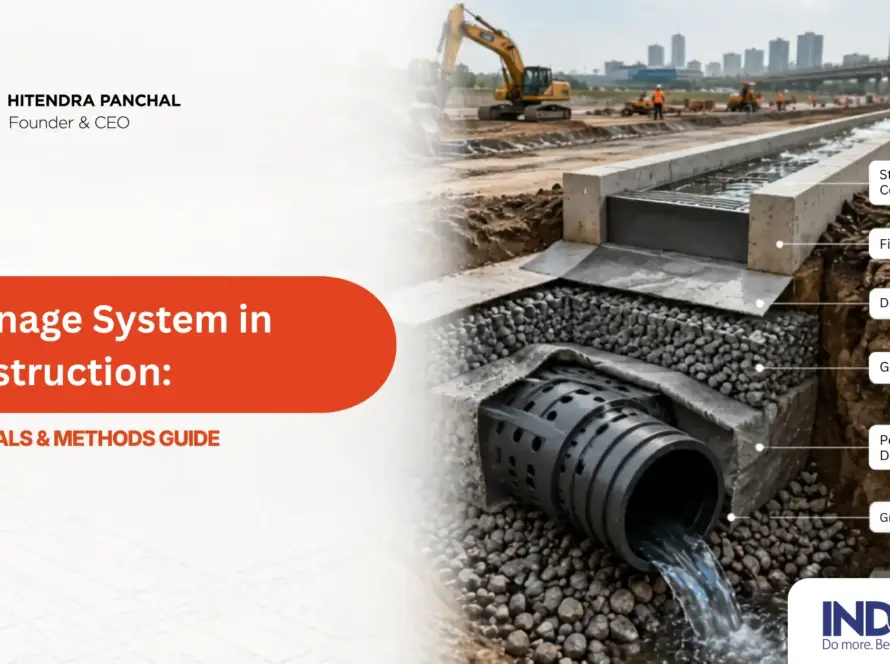
A landfill liner is a system, not a sheet. The geomembrane seals; a drainage layer above it pulls leachate off before it can pond and find a weak seam. That drainage layer is our part of the job.
A modern landfill base stacks compacted clay, the HDPE geomembrane, a leachate collection and drainage layer, and a protection geotextile. Each layer depends on the one below it.
The Liner, Protection, and Leachate Drainage
The geomembrane blocks leachate from reaching groundwater. Above it, a drainage geonet or composite has to carry that leachate to collection pipes, because trapped leachate and gas build pressure until they force a path out.
That drainage role is the job of a geonet for landfill drainage. In India, landfill containment follows CPCB solid-waste rules, which require exactly this engineered liner-and-drainage system.
Landfill Layer | Role |
|---|---|
Protection geotextile | Cushions the liner from waste |
Drainage layer | Carries leachate to collection |
HDPE geomembrane | Seals against leakage |
Compacted clay | Backup barrier |
Common Problems and Engineering Solutions
Most geomembrane failures trace to subgrade preparation, seaming, UV exposure, or uncertified material, and each has a known fix. Field data across projects points to the same short list.
Knowing the failure modes before you specify is what separates a liner that lasts from one that fails in the first few years.
The Four Failures That Recur
A puncture in year one nearly always means the same thing. Either the subgrade still had stones over 20 mm, or nobody laid a protection fabric. The fix: compact the subgrade, then a 200 to 400 gsm nonwoven cushion under the liner.
Seams that separate after a few years point to dirty or wet welding, or seams nobody tested. Weld clean and dry at 220 to 240 degrees, then peel-test.
Brittle cracking on an exposed pond means low carbon black or unstabilized resin. Fish dying off a new liner means uncertified material leaching, so specify an NSF grade and that problem goes away.
Problem | Root Cause | Solution |
|---|---|---|
Early puncture | Poor subgrade, no cushion | Clear stones, add protection geotextile |
Seam failure | Bad welding, no testing | Weld clean and dry, peel-test seams |
Brittle cracking | Low carbon black, UV | Specify 2 to 3 percent, cover early |
Water contamination | Uncertified liner | Require NSF or food-grade certification |
Geomembrane and Pond Liner in Indian Practice
In India, HDPE geomembranes follow IS 16352, landfill liners follow CPCB rules, and canal and pond lining rides on the national water missions. Standards and schemes both push the same way.
This is where a specification stands or falls on Indian sites. Global data sheets quote GRI and ASTM, but Indian government and institutional work asks for BIS-certified material.
IS 16352, CPCB Rules, and Water Missions
IS 16352:2020 sets the technical specification for HDPE geomembranes used in lining, covering strength, chemical resistance, and durability, and BIS certification is frequently mandatory on public projects.
For landfills, CPCB solid-waste rules require a liner and leachate system. For irrigation and drinking-water storage, the water missions specify lined canals, reservoirs, and check dams to stop the seepage that has always drained them.
Application | Indian Reference |
|---|---|
HDPE geomembrane lining | IS 16352:2020 |
Landfill liner and leachate | CPCB solid-waste rules |
Potable water storage | NSF or equivalent grade |
Canal and reservoir lining | Water-mission specifications |
How to Choose the Right Geomembrane: A Procurement Checklist
Four things drive the spec: the liquid, the exposure, the settlement, and the design life. Confirm the mechanical numbers against a mill test report before you order. A checklist beats a guess every time.
Get the material family right first, then lock the numbers and the certification. The steps below are the ones that protect a project on delivery.
The Selection Checklist
Start with the site. Big or aggressive means HDPE at 1.0 to 1.5 mm or thicker; irregular or settling ground means LLDPE; small and shaped means PVC. For anything left exposed, insist on 2 to 3 percent carbon black and a UV test.
Then check the numbers. Ask for GRI-GM13 compliance, thickness held within 5 percent, and a 10 square metre sample tested for tensile, puncture, and OIT before you commit to the roll.
And plan the whole stack. A drainage composite and a protection geotextile are what let the liner reach the life it’s rated for.
Factor | What to Specify |
|---|---|
Contained liquid | Chemical resistance and certification |
UV and exposure | Carbon black 2 to 3 percent, UV test |
Ground settlement | LLDPE where movement is expected |
Design life | Thickness and OIT to match |
Certification | IS 16352 or BIS for government work |
Plan the System, Not Just the Sheet
A geomembrane is not a product you buy by the roll and forget. It is the barrier at the heart of a system, and the protection and drainage layers around it decide whether it reaches its rated life.
Specify the material for the liquid and the exposure. Set the thickness and the certification to the risk and the design life. Then give the liner the cushion and drainage it needs to survive settlement, pressure, and time.
Do that and a liner holds for decades on a fish pond, a canal, or a landfill alike. For the geotextile protection and drainage geosynthetics that go with your liner, the team at Indonet Group can specify them to your site and standards.
Frequently Asked Questions
What is a geomembrane?
A geomembrane is a near-impermeable synthetic sheet, usually HDPE, LLDPE, or PVC, used to line ponds, canals, reservoirs, and landfills so liquid or gas can’t leak through. It is the barrier layer in a lined containment system.
What is the difference between a geomembrane and a pond liner?
A pond liner is a geomembrane used to line a pond. Geomembrane is the broad term for the impermeable sheet, while pond liner, canal liner, and landfill liner name the specific application.
Which geomembrane is best for a pond?
For most farm and industrial ponds, an HDPE liner offers the best mix of durability and chemical resistance. For small, irregular, or decorative ponds, flexible LLDPE or PVC conforms to the shape more easily.
What thickness of geomembrane do I need?
Thickness follows the application. Aquaculture ponds use 0.75 to 1.0 mm, canals and reservoirs 1.0 to 1.5 mm, and landfills 1.5 to 3.0 mm. Match thickness to exposure, head pressure, and design life.
Which Indian standard covers geomembranes?
HDPE geomembranes used for lining in India are specified to IS 16352:2020. Landfill liner systems also follow CPCB solid-waste rules, and international projects reference GRI-GM13 for HDPE and GRI-GM17 for LLDPE.
Does a geomembrane need a drainage or protection layer?
Yes, on most engineered sites. A protection geotextile of 200 to 400 gsm shields the liner from puncture, and a drainage geonet or composite relieves water, gas, or leachate behind it, both of which extend service life.
How long does a geomembrane liner last?
A well-specified HDPE geomembrane lasts 50 years or more, given proper welding and protection. LLDPE lasts 15 to 25 years and PVC 5 to 10, so grade, carbon black, and installation matter as much as the material.

Hitendra Panchal
Founder & CEOMr. Panchal is on a mission to revolutionize India's plastics landscape. Under his leadership, Indonet delivers essential solutions that fortify infrastructure, construction, and agriculture projects. Since 2007, he has built a manufacturing powerhouse specializing in high-performance geosynthetics and extruded netting.A champion of the "Make in India" initiative, he drives sustainable innovation to build resilient supply chains. Mr. Panchal empowers businesses to enhance project integrity and long-term value through world-class, engineered plastic solutions trusted globally.